











OHKF Advocates Construction of the Inter-Airport Railway Aligning with National Strategy, Cementing Hong Kong’s Aviation Hub Status, and Strengthening Regional Connectivity




OHKF Advocates Construction of the Inter-Airport Railway Aligning with National Strategy, Cementing Hong Kong’s Aviation Hub Status, and Strengthening Regional Connectivity

(20 November 2025, Hong Kong) Our Hong Kong Foundation (OHKF) released its latest research report (the report) entitled Laying the Tracks to Future-Proof Hong Kong’s Status as an International Aviation Hub. The report advocates the development of a new, dedicated Hong Kong–Shenzhen Inter-Airport Railway (IAR) that directly links the Hong Kong International Airport (HKG) with the national high-speed rail (HSR) network. This would transform Hong Kong from a geographical endpoint into a critical node for air-to-rail intermodal transport in the Greater Bay Area (GBA), while strengthening the “Central–Qianhai” dual-core linkage between Hong Kong and Shenzhen through deeper integration of key metropolitan areas.
National Air-to-Rail Intermodal Strategy Set to Reshape the GBA
Transport planning in the National 14th Five-Year Plan established a core objective to advance the “integration of air and rail transport”, pushing for the coordinated planning and shared use of infrastructure between airports and railway stations to create a seamless passenger experience. The plan stipulates that by 2025, 80% of international and regional aviation hubs nationwide should have a railway connection. In response, airports across the country are not only adding conventional rail links but are also actively building direct HSR connections to passenger terminals.
The GBA is also actively responding to this national strategy, proposing the construction of the Second Guangzhou–Shenzhen HSR—expected to be operational before 2035—to create a “world-class airport cluster on the rail”. Once completed, the travel time between the Guangzhou Baiyun International Airport and Shenzhen Bao’an International Airport (SZX) will be reduced to approximately 40 minutes, thereby reshaping passenger flows and flight route configurations in the GBA. It must be noted that once new travel habits and operating patterns are established, they will become deeply entrenched and difficult to reverse.
Hong Kong’s Advantage Is Narrowing and Strengthening Connectivity Is Urgently Needed
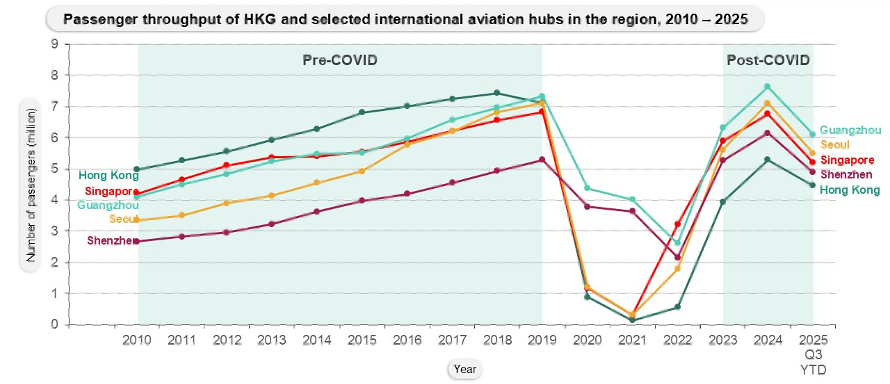
The report points out that compared to regional aviation hubs such as Singapore, Seoul, Guangzhou, and Shenzhen, HKG’s lead in passenger throughput had already begun narrowing before COVID and was overtaken post-COVID (Figure 1).
Therefore, “doing nothing” and relying solely on the increased runway capacity from the Three-Runway System (3RS) to maintain competitiveness is not a viable strategy. After the completion of the Second Guangzhou-Shenzhen HSR, the 3RS may not reach its full capacity potential, making it difficult to justify this major public investment and potentially weakening Hong Kong’s position within the regional landscape.
Worryingly, much of the public and relevant stakeholders remain largely unaware of these national development plans for air-to-rail intermodal transport and the competitive landscape of regional air transport. If Hong Kong remains complacent and fails to integrate proactively into the GBA’s air-to-rail intermodal transportation cluster, it risks gradual marginalisation. The city could find itself transformed from a premier international gateway into a relative backwater, disconnected from the main currents of regional travel and commerce.
Extending the Hong Kong-Shenzhen Western Rail Link (HSWRL) to Achieve Major Strategic Objectives
The report recommends extending the upcoming HSWRL, scheduled to be operational by 2035, from its planned terminus in Shenzhen at Qianhai to SZX, and from its Hong Kong terminus at Hung Shui Kiu to HKG. Crucially, the proposed extension to the airports should be developed concurrently to be operational by 2035, minimising any gap with the Second Guangzhou–Shenzhen HSR and, at best, preventing further slippage in HKG’s regional connectivity.
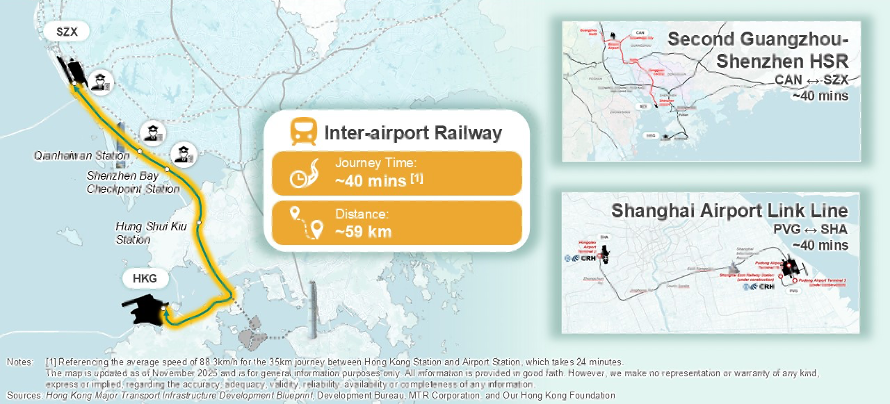
The IAR directly links HKG to the national HSR network via SZX, shortening travel time between the two airports to approximately 40 minutes, providing a reliable, predictable and all-weather dedicated corridor between HKG and SZX (Figure 2). This 40-minute journey is a critical competitive benchmark, matching the performance of other airport-to-airport rail links such as Shanghai’s Airport Link Line and the upcoming Second Guangzhou–Shenzhen HSR.
Through in-depth analysis, the report points out that the IAR holds significant strategic importance, as it represents a key initiative for Hong Kong to respond to the national air-to-rail intermodal transportation strategy. By connecting to the GBA and the national rail network, this would transform HKG from a geographical endpoint into a regional intermodal transport node. This not only prevents Hong Kong from being marginalised in regional competition, but also leverages the vast passenger base of the GBA and even broader regions to bring sustainable growth momentum to HKG, thereby cementing its status as an international aviation hub.
Through various station configurations, such as adding a station at Sunny Bay connecting to the Tung Chung Line, the IAR would create an alternative route to the airport, significantly enhancing the resilience of the railway network. This would not only facilitate faster airport access for residents in New Territories West, but, more importantly, link the Northern Metropolis, Lantau Island, and the Harbour Metropolis, enabling the efficient integration of these three strategic areas. Furthermore, it would realise rapid connectivity between the twin commercial cores of Hong Kong and Shenzhen—Central and Qianhai—thereby accelerating the two-way flow of talent, capital, and technology. By closely linking Hong Kong’s international financial centre with Shenzhen’s technological innovation hub, Hong Kong can better serve mainland enterprises to expand into global markets, further enhancing Hong Kong’s unique functions and contributions within the GBA and broader national development.
Dr Jane Lee, President of OHKF, said: “The IAR is a critical step for Hong Kong to integrate into the national strategy of ‘air-to-rail intermodal transport’, and its significance extends far beyond mere transport infrastructure. This corridor will cement Hong Kong’s position as an international aviation hub, enhance the resilience of the local rail network, and promote a synergistic ‘finance + technology’ partnership between Hong Kong and Shenzhen. It is a strategic choice for Hong Kong to proactively participate in the development of the GBA and avoid being marginalised by the tide of regional progress.”
Mr Ryan Ip, Vice President of OHKF and Executive Director of Public Policy Institute, remarked: “Time is Hong Kong’s greatest challenge. If we fail to seize the critical window and concurrently complete the IAR before the Second Guangzhou-Shenzhen HSR becomes operational by 2035, Hong Kong risks being excluded from the GBA’s ‘airport cluster on the rail’. This would not only lead to underutilised capacity of the 3RS, but could also relegate Hong Kong from a regional hub to a logistical island, fundamentally undermining the city’s long-term competitiveness.”
Mr Jason Leung, Head of Land and Housing of OHKF commented: “The IAR will ‘grow the pie’ in the GBA aviation market in two ways, rather than merely redistributing existing traffic among regional airports. First, it will generate induced demand—increased propensity to travel among passengers due to improved service and accessibility. Second, it will capture transfer/transit traffic by creating a Hong Kong–Shenzhen transfer hub, retaining passengers who might otherwise transit through other overseas hubs when travelling to and from the Chinese mainland.”
Laying the Tracks to Future-Proof Hong Kong’s Status as an International Aviation Hub
Full report:https: https://bit.ly/4idVY3Y
Presentation Slides: https://bit.ly/4a0Brxw







(20 November 2025, Hong Kong) Our Hong Kong Foundation (OHKF) released its latest research report (the report) entitled Laying the Tracks to Future-Proof Hong Kong’s Status as an International Aviation Hub. The report advocates the development of a new, dedicated Hong Kong–Shenzhen Inter-Airport Railway (IAR) that directly links the Hong Kong International Airport (HKG) with the national high-speed rail (HSR) network. This would transform Hong Kong from a geographical endpoint into a critical node for air-to-rail intermodal transport in the Greater Bay Area (GBA), while strengthening the “Central–Qianhai” dual-core linkage between Hong Kong and Shenzhen through deeper integration of key metropolitan areas.
National Air-to-Rail Intermodal Strategy Set to Reshape the GBA
Transport planning in the National 14th Five-Year Plan established a core objective to advance the “integration of air and rail transport”, pushing for the coordinated planning and shared use of infrastructure between airports and railway stations to create a seamless passenger experience. The plan stipulates that by 2025, 80% of international and regional aviation hubs nationwide should have a railway connection. In response, airports across the country are not only adding conventional rail links but are also actively building direct HSR connections to passenger terminals.
The GBA is also actively responding to this national strategy, proposing the construction of the Second Guangzhou–Shenzhen HSR—expected to be operational before 2035—to create a “world-class airport cluster on the rail”. Once completed, the travel time between the Guangzhou Baiyun International Airport and Shenzhen Bao’an International Airport (SZX) will be reduced to approximately 40 minutes, thereby reshaping passenger flows and flight route configurations in the GBA. It must be noted that once new travel habits and operating patterns are established, they will become deeply entrenched and difficult to reverse.
Hong Kong’s Advantage Is Narrowing and Strengthening Connectivity Is Urgently Needed
The report points out that compared to regional aviation hubs such as Singapore, Seoul, Guangzhou, and Shenzhen, HKG’s lead in passenger throughput had already begun narrowing before COVID and was overtaken post-COVID (Figure 1).
Therefore, “doing nothing” and relying solely on the increased runway capacity from the Three-Runway System (3RS) to maintain competitiveness is not a viable strategy. After the completion of the Second Guangzhou-Shenzhen HSR, the 3RS may not reach its full capacity potential, making it difficult to justify this major public investment and potentially weakening Hong Kong’s position within the regional landscape.
Worryingly, much of the public and relevant stakeholders remain largely unaware of these national development plans for air-to-rail intermodal transport and the competitive landscape of regional air transport. If Hong Kong remains complacent and fails to integrate proactively into the GBA’s air-to-rail intermodal transportation cluster, it risks gradual marginalisation. The city could find itself transformed from a premier international gateway into a relative backwater, disconnected from the main currents of regional travel and commerce.
Extending the Hong Kong-Shenzhen Western Rail Link (HSWRL) to Achieve Major Strategic Objectives
The report recommends extending the upcoming HSWRL, scheduled to be operational by 2035, from its planned terminus in Shenzhen at Qianhai to SZX, and from its Hong Kong terminus at Hung Shui Kiu to HKG. Crucially, the proposed extension to the airports should be developed concurrently to be operational by 2035, minimising any gap with the Second Guangzhou–Shenzhen HSR and, at best, preventing further slippage in HKG’s regional connectivity.
The IAR directly links HKG to the national HSR network via SZX, shortening travel time between the two airports to approximately 40 minutes, providing a reliable, predictable and all-weather dedicated corridor between HKG and SZX (Figure 2). This 40-minute journey is a critical competitive benchmark, matching the performance of other airport-to-airport rail links such as Shanghai’s Airport Link Line and the upcoming Second Guangzhou–Shenzhen HSR.
Through in-depth analysis, the report points out that the IAR holds significant strategic importance, as it represents a key initiative for Hong Kong to respond to the national air-to-rail intermodal transportation strategy. By connecting to the GBA and the national rail network, this would transform HKG from a geographical endpoint into a regional intermodal transport node. This not only prevents Hong Kong from being marginalised in regional competition, but also leverages the vast passenger base of the GBA and even broader regions to bring sustainable growth momentum to HKG, thereby cementing its status as an international aviation hub.
Through various station configurations, such as adding a station at Sunny Bay connecting to the Tung Chung Line, the IAR would create an alternative route to the airport, significantly enhancing the resilience of the railway network. This would not only facilitate faster airport access for residents in New Territories West, but, more importantly, link the Northern Metropolis, Lantau Island, and the Harbour Metropolis, enabling the efficient integration of these three strategic areas. Furthermore, it would realise rapid connectivity between the twin commercial cores of Hong Kong and Shenzhen—Central and Qianhai—thereby accelerating the two-way flow of talent, capital, and technology. By closely linking Hong Kong’s international financial centre with Shenzhen’s technological innovation hub, Hong Kong can better serve mainland enterprises to expand into global markets, further enhancing Hong Kong’s unique functions and contributions within the GBA and broader national development.
Dr Jane Lee, President of OHKF, said: “The IAR is a critical step for Hong Kong to integrate into the national strategy of ‘air-to-rail intermodal transport’, and its significance extends far beyond mere transport infrastructure. This corridor will cement Hong Kong’s position as an international aviation hub, enhance the resilience of the local rail network, and promote a synergistic ‘finance + technology’ partnership between Hong Kong and Shenzhen. It is a strategic choice for Hong Kong to proactively participate in the development of the GBA and avoid being marginalised by the tide of regional progress.”
Mr Ryan Ip, Vice President of OHKF and Executive Director of Public Policy Institute, remarked: “Time is Hong Kong’s greatest challenge. If we fail to seize the critical window and concurrently complete the IAR before the Second Guangzhou-Shenzhen HSR becomes operational by 2035, Hong Kong risks being excluded from the GBA’s ‘airport cluster on the rail’. This would not only lead to underutilised capacity of the 3RS, but could also relegate Hong Kong from a regional hub to a logistical island, fundamentally undermining the city’s long-term competitiveness.”
Mr Jason Leung, Head of Land and Housing of OHKF commented: “The IAR will ‘grow the pie’ in the GBA aviation market in two ways, rather than merely redistributing existing traffic among regional airports. First, it will generate induced demand—increased propensity to travel among passengers due to improved service and accessibility. Second, it will capture transfer/transit traffic by creating a Hong Kong–Shenzhen transfer hub, retaining passengers who might otherwise transit through other overseas hubs when travelling to and from the Chinese mainland.”
Laying the Tracks to Future-Proof Hong Kong’s Status as an International Aviation Hub
Full report:https: https://bit.ly/4idVY3Y
Presentation Slides: https://bit.ly/4a0Brxw