







Bridging Healthcare and Community for Holistic Health: The Development of Social Prescribing in Hong Kong




Bridging Healthcare and Community for Holistic Health: The Development of Social Prescribing in Hong Kong

Hong Kong is moving towards its first five-year plan, which is expected to continue and deepen healthcare reforms in primary healthcare and person-centred care. However, people’s health needs extend beyond the diagnosis and treatment of illness. The social determinants of health (SDoH), including social, economic, environmental and community conditions, also have a profound impact on individual health. Issues such as lifestyle, loneliness and caregiving pressure cannot be addressed through clinical interventions alone. Yet, challenges remain in collaboration and workforce capacity between healthcare and social welfare services, making it difficult for many people in need to receive timely support.
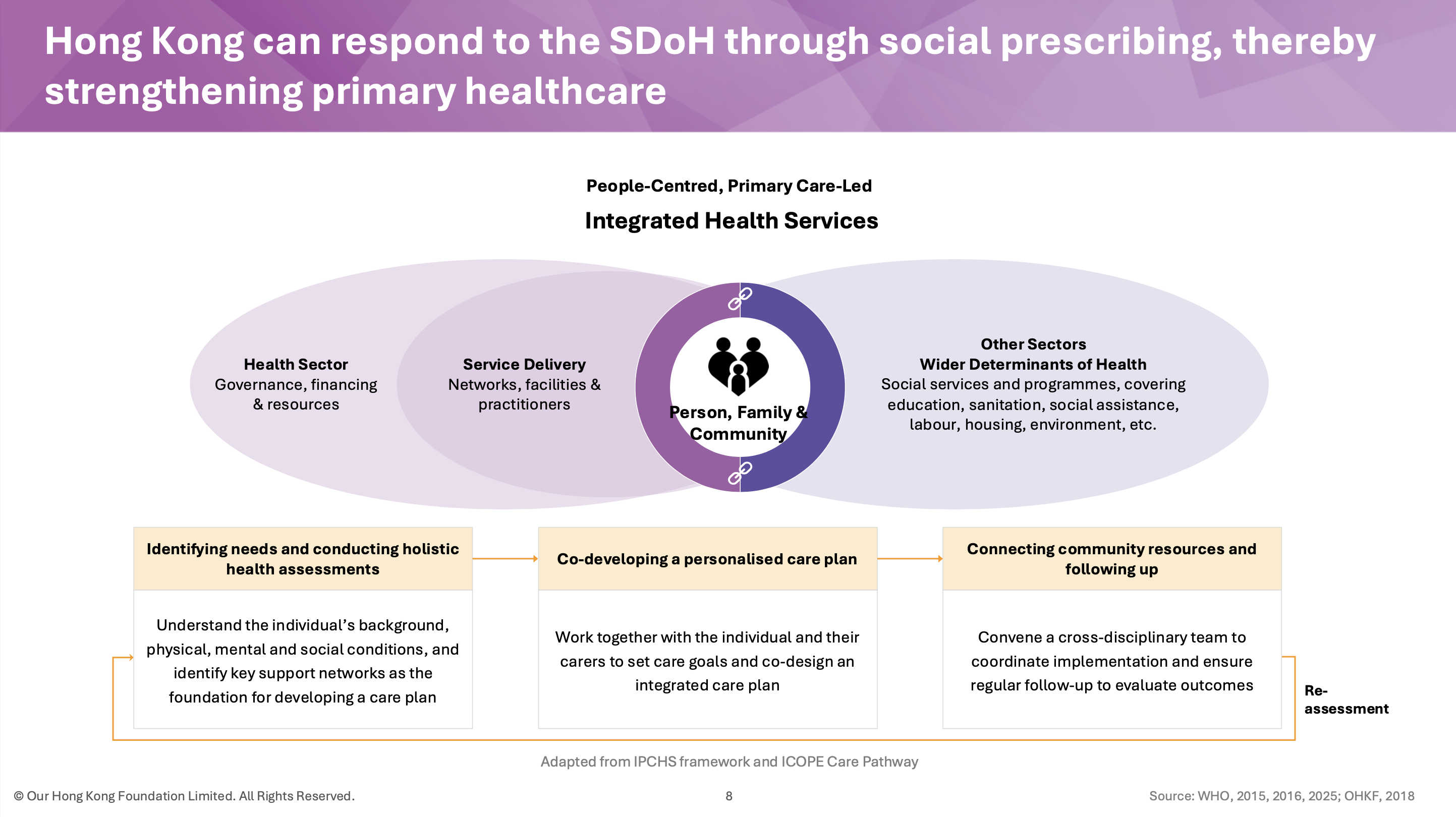
Our Hong Kong Foundation (OHKF) advocates promoting social prescribing to further advance the community-based primary healthcare system. Through Link Workers, social prescribing connects residents in need with non-clinical community resources and services, thereby addressing the SDoH. Link Workers adopt a holistic health perspective to identify diverse needs of service users, co-develop personalised care plans with them, and facilitate their access to suitable community resources, such as physical activities, gardening, psychosocial programmes, and more.
Therefore, social prescribing is not intended to replace diagnosis or treatment, but rather to complement healthcare services by addressing needs that medical care alone may not fully resolve, including but not limited to loneliness, caregiver stress, and insufficient participation in activities, thereby fostering social connections, self-management, and a sense of purpose.
Today, social prescribing has already gained empirical support, both locally and internationally, for its effectiveness, with service users ranging from adolescents to older adults and from primary care patients to individuals in rehabilitation. Initial evidence in Hong Kong suggests that these services can help reduce loneliness and anxiety, improve sleep quality, physical functioning, and overall physical and mental well-being.
The next step is to progressively develop social prescribing into a more structured referral pathway among healthcare, social welfare and community organisations, while retaining programme flexibility. This would allow residents to receive appropriate support before their needs become more complex. OHKF proposes developing a local social prescribing framework that includes:
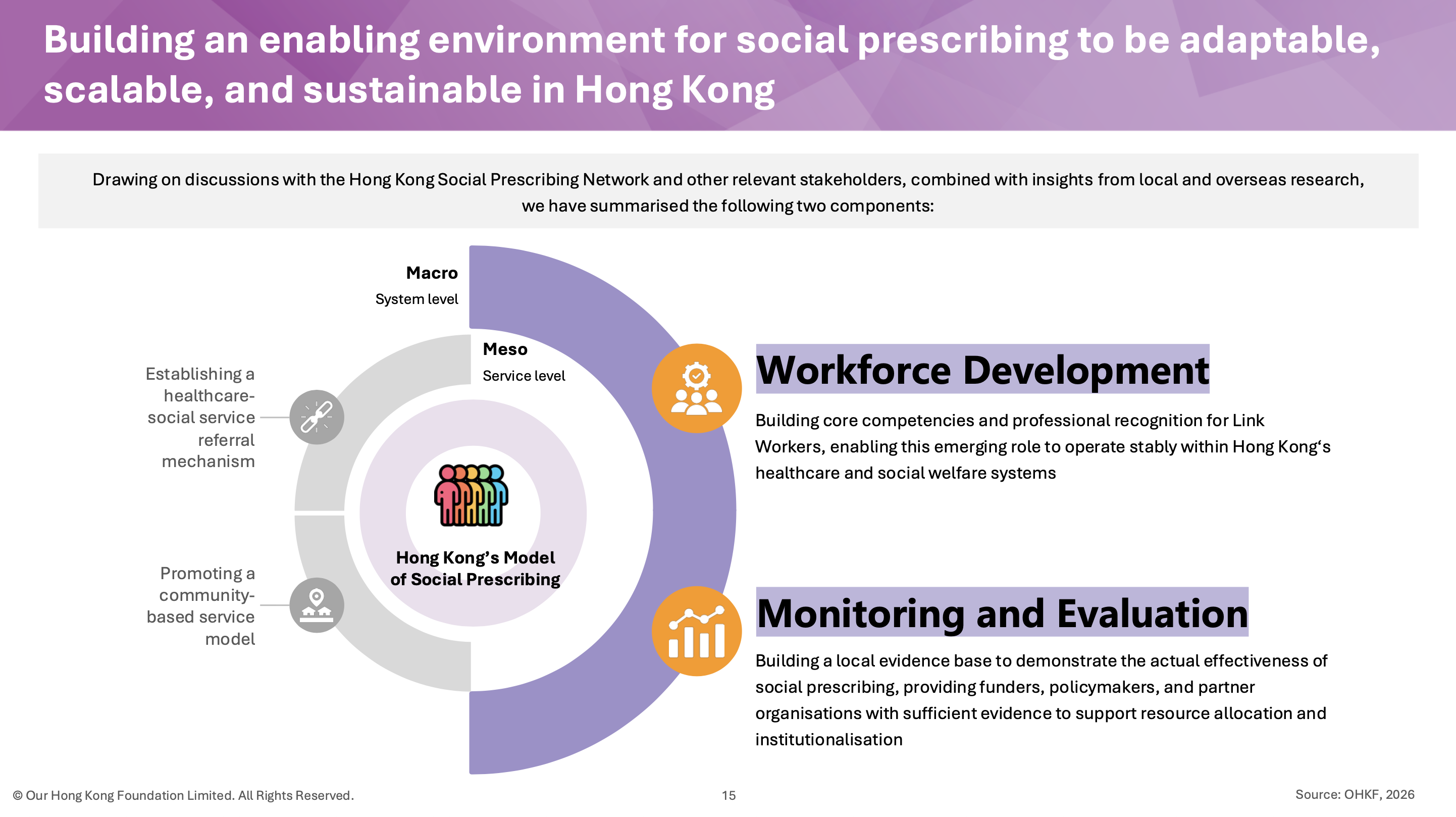
Developing a professionally recognised workforce system for Link Workers, with a shared competency framework, training requirements and a progressive accreditation pathway.
Establishing a systematic social impact assessment framework, using universal core indicators to assess outcomes and impacts for service users, services and the wider system, while allowing flexible indicators for different service-user groups.
Through this study, OHKF aims to consolidate practical experience of social prescribing in Hong Kong and clarify the common foundations required for service development and evaluation. This will help strengthen collaboration across healthcare, social care and community services, enabling social prescribing to respond more effectively to people’s needs.



Hong Kong is moving towards its first five-year plan, which is expected to continue and deepen healthcare reforms in primary healthcare and person-centred care. However, people’s health needs extend beyond the diagnosis and treatment of illness. The social determinants of health (SDoH), including social, economic, environmental and community conditions, also have a profound impact on individual health. Issues such as lifestyle, loneliness and caregiving pressure cannot be addressed through clinical interventions alone. Yet, challenges remain in collaboration and workforce capacity between healthcare and social welfare services, making it difficult for many people in need to receive timely support.
Our Hong Kong Foundation (OHKF) advocates promoting social prescribing to further advance the community-based primary healthcare system. Through Link Workers, social prescribing connects residents in need with non-clinical community resources and services, thereby addressing the SDoH. Link Workers adopt a holistic health perspective to identify diverse needs of service users, co-develop personalised care plans with them, and facilitate their access to suitable community resources, such as physical activities, gardening, psychosocial programmes, and more.
Therefore, social prescribing is not intended to replace diagnosis or treatment, but rather to complement healthcare services by addressing needs that medical care alone may not fully resolve, including but not limited to loneliness, caregiver stress, and insufficient participation in activities, thereby fostering social connections, self-management, and a sense of purpose.
Today, social prescribing has already gained empirical support, both locally and internationally, for its effectiveness, with service users ranging from adolescents to older adults and from primary care patients to individuals in rehabilitation. Initial evidence in Hong Kong suggests that these services can help reduce loneliness and anxiety, improve sleep quality, physical functioning, and overall physical and mental well-being.
The next step is to progressively develop social prescribing into a more structured referral pathway among healthcare, social welfare and community organisations, while retaining programme flexibility. This would allow residents to receive appropriate support before their needs become more complex. OHKF proposes developing a local social prescribing framework that includes:
Developing a professionally recognised workforce system for Link Workers, with a shared competency framework, training requirements and a progressive accreditation pathway.
Establishing a systematic social impact assessment framework, using universal core indicators to assess outcomes and impacts for service users, services and the wider system, while allowing flexible indicators for different service-user groups.
Through this study, OHKF aims to consolidate practical experience of social prescribing in Hong Kong and clarify the common foundations required for service development and evaluation. This will help strengthen collaboration across healthcare, social care and community services, enabling social prescribing to respond more effectively to people’s needs.