









Fit to Practise: Strengthening Hong Kong’s Doctor Workforce Today for a Better Tomorrow




Fit to Practise: Strengthening Hong Kong’s Doctor Workforce Today for a Better Tomorrow

Hong Kong is renowned for its efficient health system and enviable for its population’s long life expectancy, but it is plagued by a longstanding doctor shortage crisis. Unless quick action is taken to address this problem, the doctor shortage gap will continue to widen, with a projected shortfall of 1,610 doctors by 2030, according to the Government’s 2020 Healthcare Manpower Projection. This contributes to potentially dangerous delays in diagnosis, treatment, and management of health conditions.
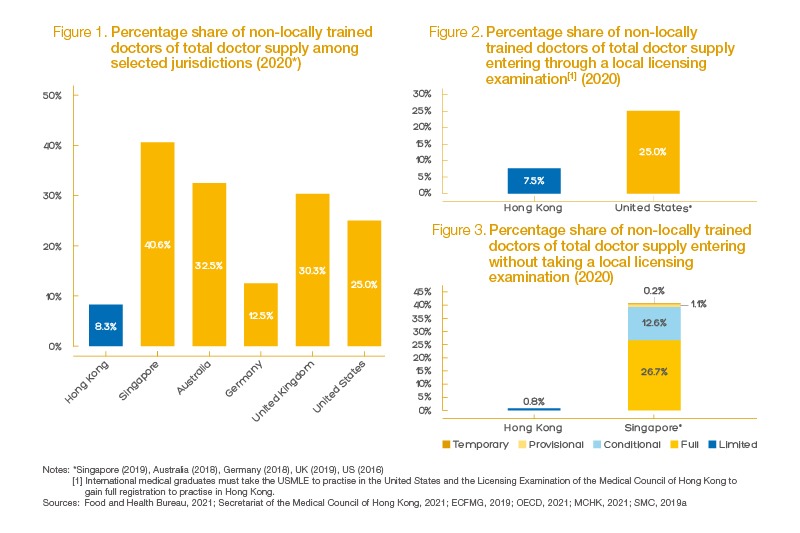
Although the Government has taken a multifaceted approach to increase Hong Kong’s doctor supply, Hong Kong has yet to fully leverage a non-locally trained doctor workforce, which is a missed opportunity to relieve the doctor shortage crisis holistically and effectively. Our research reveals that Hong Kong’s policy efforts to encourage the practice of non-locally trained doctors fall behind those in similarly developed economies such as Singapore and the United States. Hong Kong’s policies around internship placements, training, accreditation and career progression for non-locally trained doctors need to be improved substantially to provide fairer opportunities for non-locally trained doctors.
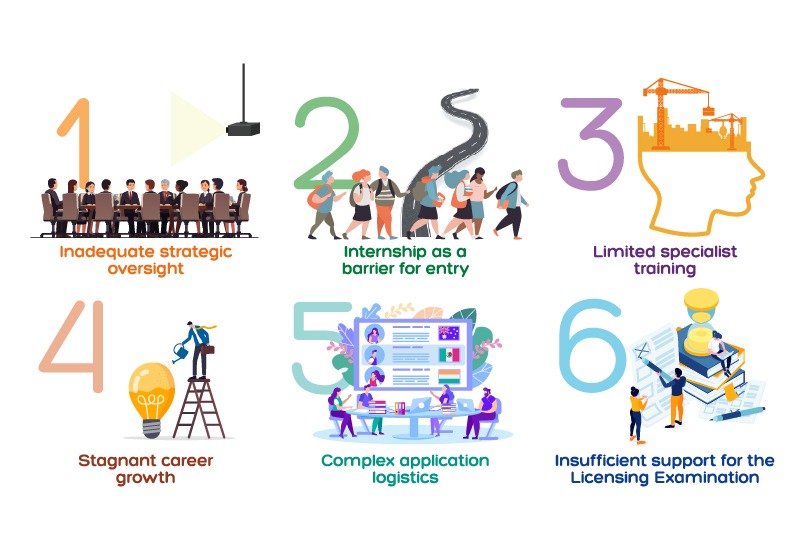
As part of a multi-pronged approach necessary to alleviate the doctor shortage crisis and inspired by exclusive interviews with non-locally trained doctors practising in Hong Kong, we put forth six policy recommendations in response to the six key challenges, so that non-locally trained doctors’ talents can be fully leveraged to provide immediate relief to the local health system:
Improve governance: 1) Hong Kong must strengthen its governance and strategic vision in health workforce.
Facilitate registration, internship, training, accreditation, and career progression: 2) Hong Kong can consider providing internship placements and a structured career path for non-locally trained doctors 3) Hong Kong should strengthen its investment in specialist training; 4) Hong Kong must capitalise on and nurture valuable human capital.
Increase efficiency and equity: 5) Relevant authorities in Hong Kong including the Medical Council of Hong Kong should adopt the Electronic Portfolio of International Credentials to streamline examination application and medical registration procedures; 6) Hong Kong should conduct a review of the Medical Council of Hong Kong Licensing Examination to uphold fair assessment standards.
For specifics, please refer to the full report.




Hong Kong is renowned for its efficient health system and enviable for its population’s long life expectancy, but it is plagued by a longstanding doctor shortage crisis. Unless quick action is taken to address this problem, the doctor shortage gap will continue to widen, with a projected shortfall of 1,610 doctors by 2030, according to the Government’s 2020 Healthcare Manpower Projection. This contributes to potentially dangerous delays in diagnosis, treatment, and management of health conditions.
Although the Government has taken a multifaceted approach to increase Hong Kong’s doctor supply, Hong Kong has yet to fully leverage a non-locally trained doctor workforce, which is a missed opportunity to relieve the doctor shortage crisis holistically and effectively. Our research reveals that Hong Kong’s policy efforts to encourage the practice of non-locally trained doctors fall behind those in similarly developed economies such as Singapore and the United States. Hong Kong’s policies around internship placements, training, accreditation and career progression for non-locally trained doctors need to be improved substantially to provide fairer opportunities for non-locally trained doctors.
As part of a multi-pronged approach necessary to alleviate the doctor shortage crisis and inspired by exclusive interviews with non-locally trained doctors practising in Hong Kong, we put forth six policy recommendations in response to the six key challenges, so that non-locally trained doctors’ talents can be fully leveraged to provide immediate relief to the local health system:
Improve governance: 1) Hong Kong must strengthen its governance and strategic vision in health workforce.
Facilitate registration, internship, training, accreditation, and career progression: 2) Hong Kong can consider providing internship placements and a structured career path for non-locally trained doctors 3) Hong Kong should strengthen its investment in specialist training; 4) Hong Kong must capitalise on and nurture valuable human capital.
Increase efficiency and equity: 5) Relevant authorities in Hong Kong including the Medical Council of Hong Kong should adopt the Electronic Portfolio of International Credentials to streamline examination application and medical registration procedures; 6) Hong Kong should conduct a review of the Medical Council of Hong Kong Licensing Examination to uphold fair assessment standards.
For specifics, please refer to the full report.