







Taking Flight – Forging a Future for Hong Kong’s Low-Altitude Economy




Taking Flight – Forging a Future for Hong Kong’s Low-Altitude Economy

As a national strategic emerging industry, the low-altitude economy is set to reshape industries, services, and daily livelihoods, while injecting new impetus into Hong Kong’s economy. Our Hong Kong Foundation released its Taking Flight – Forging a Future for Hong Kong’s Low-Altitude Economy report, providing a comprehensive analysis of how Hong Kong could capture the cream of crop in the low-altitude economy.
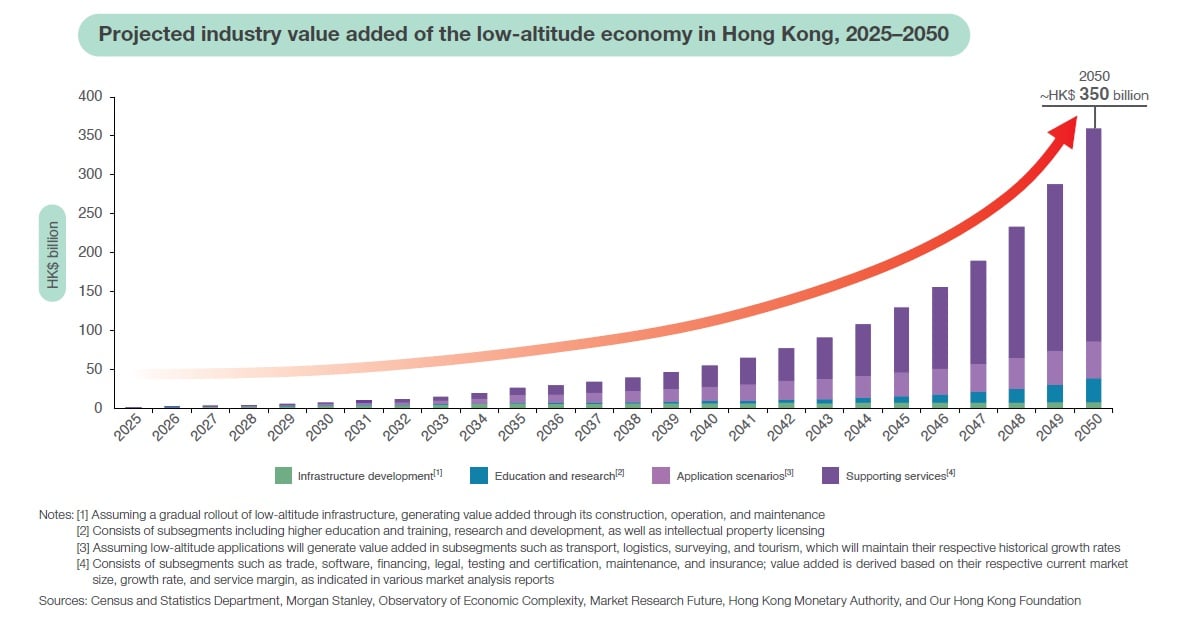
Projected industry value added of the low-altitude economy to Hong Kong
To evaluate the potential economic contribution of the low-altitude economy to Hong Kong, this report has adopted a value-added approach. Accordingly, the low-altitude economy is broken down into four key segments: infrastructure development, education and research, application scenarios, and supporting services. With these assumptions applied, it is projected that the industry value added of the low-altitude economy in Hong Kong will reach approximately HK$ 350 billion in 2050, with the majority of value generated in supporting services.
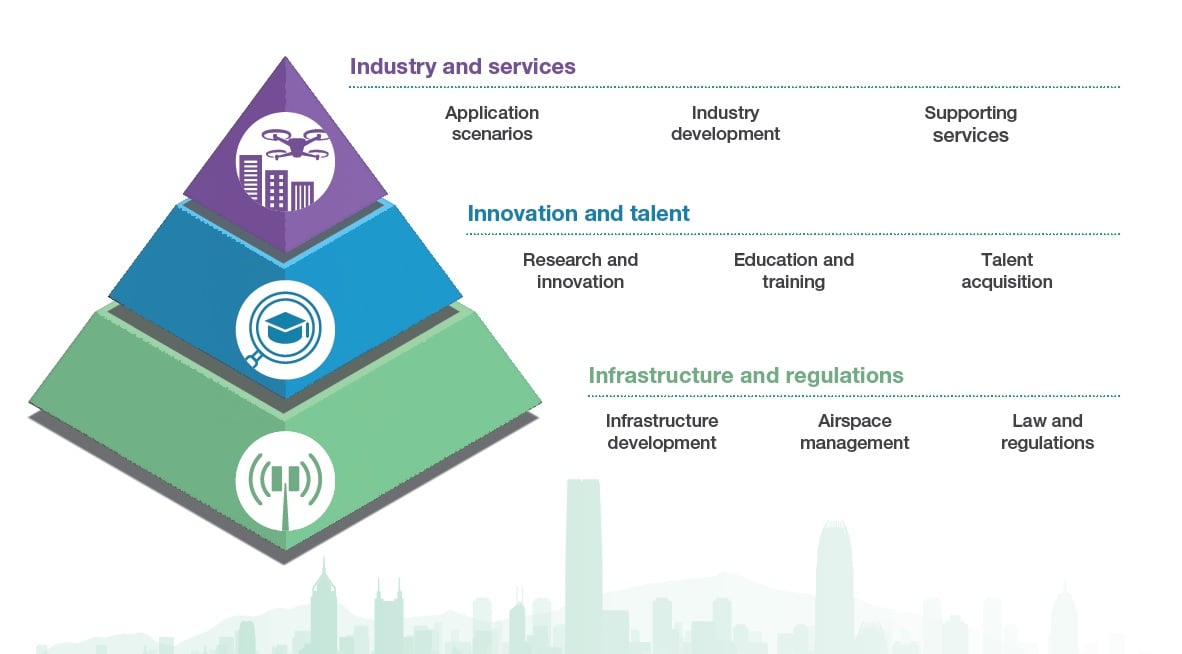
A step-by-step approach to developing the low-altitude economy
Nevertheless, a step-by-step approach is required. This can be visualised as a pyramid framework constructed from multiple interconnected building blocks, grounded on infrastructure and regulations, followed by innovation and talent, and finally culminating in industry and services. In each layer, there is an overarching vision, a corresponding strategy, actionable recommendations, and the way forward.
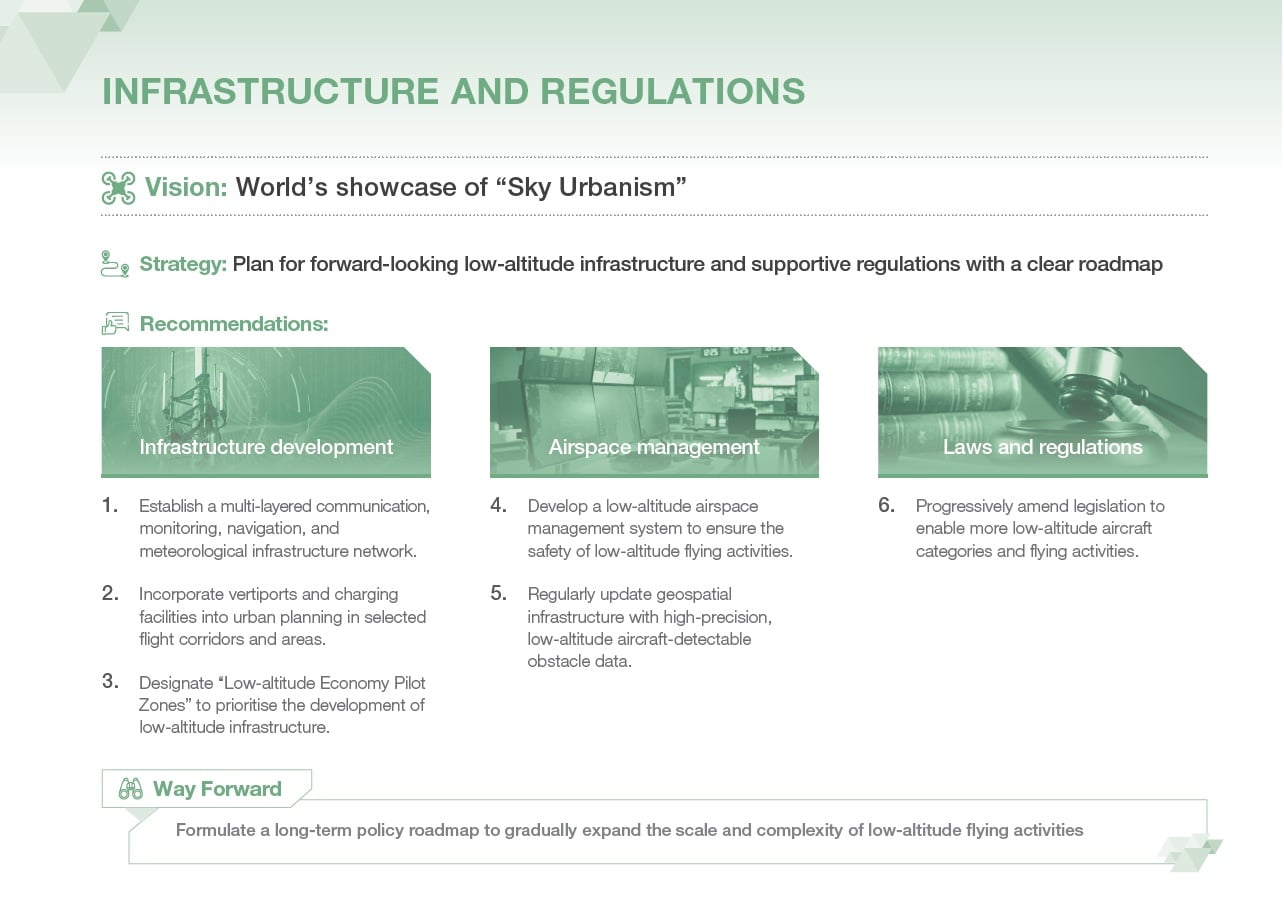
Infrastructure and regulations
As the foundation for the low-altitude economy to “fly steady”, infrastructure and regulations can help shape Hong Kong into the world’s showcase of “Sky Urbanism”. Realising this, however, would require Hong Kong to support infrastructure development on the hardware side by using various implementation models, e.g., public-private partnership to install vertiports, charging facilities, and high-speed communication networks. For software, an airspace management system is needed to ensure the safe and efficient operation of low-altitude flying activities. Accordingly, laws and regulations need to be amended or created to facilitate the safe development of emerging low-altitude aircraft and flying activities.
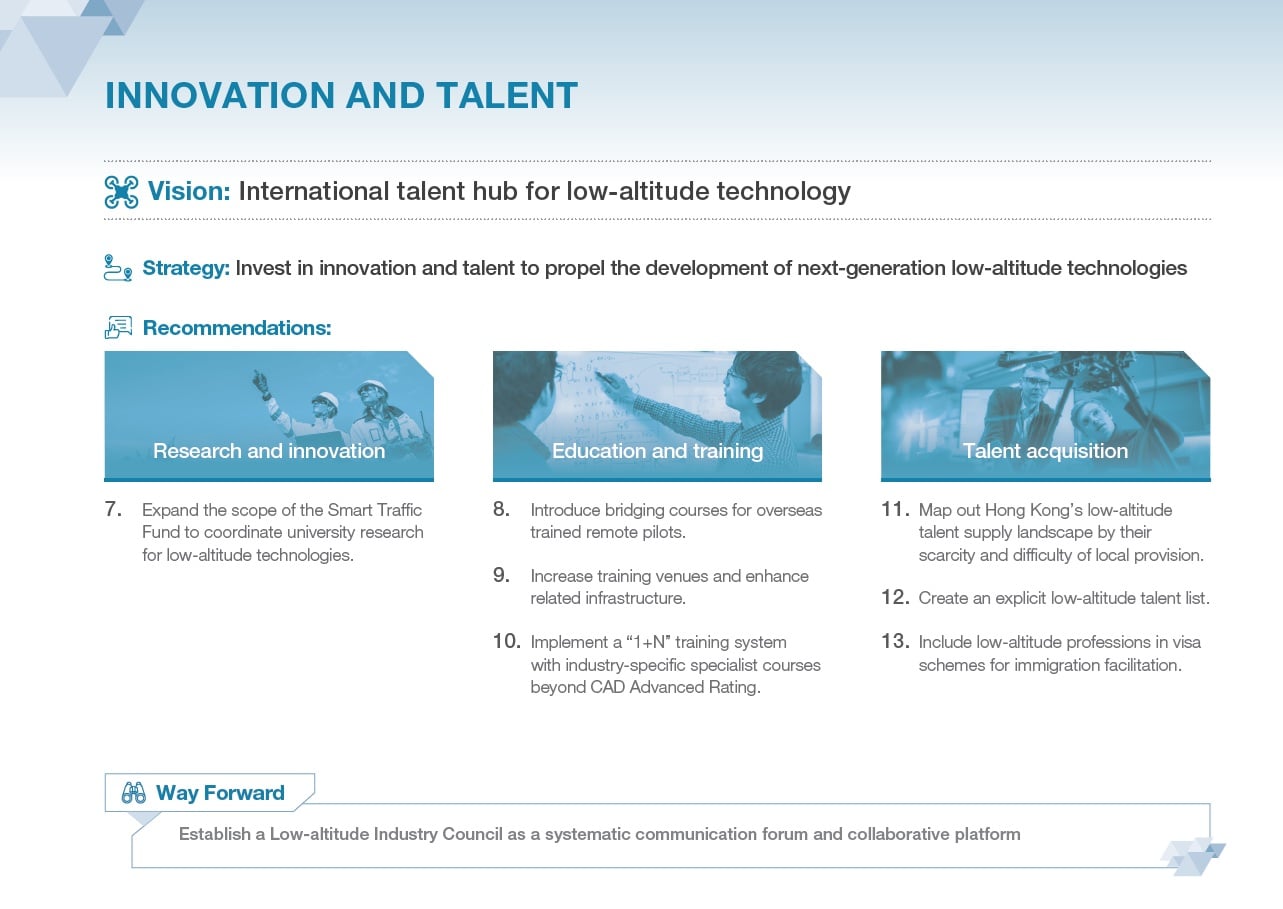
Innovation and talent
Innovation and talent will enable the low-altitude economy “fly far”, building Hong Kong into an international talent hub for low-altitude technology. To this end, research and innovation in low-altitude technology need to be coordinated to focus on where they are most needed. Meanwhile, the workforce has to be upskilled via more rigorous requirements and a systematic curriculum in education and training. Moreover, talent acquisition policies also require timely review to attract low-altitude talent, positioning Hong Kong as a leader in next-generation low-altitude technologies.
Industry and services
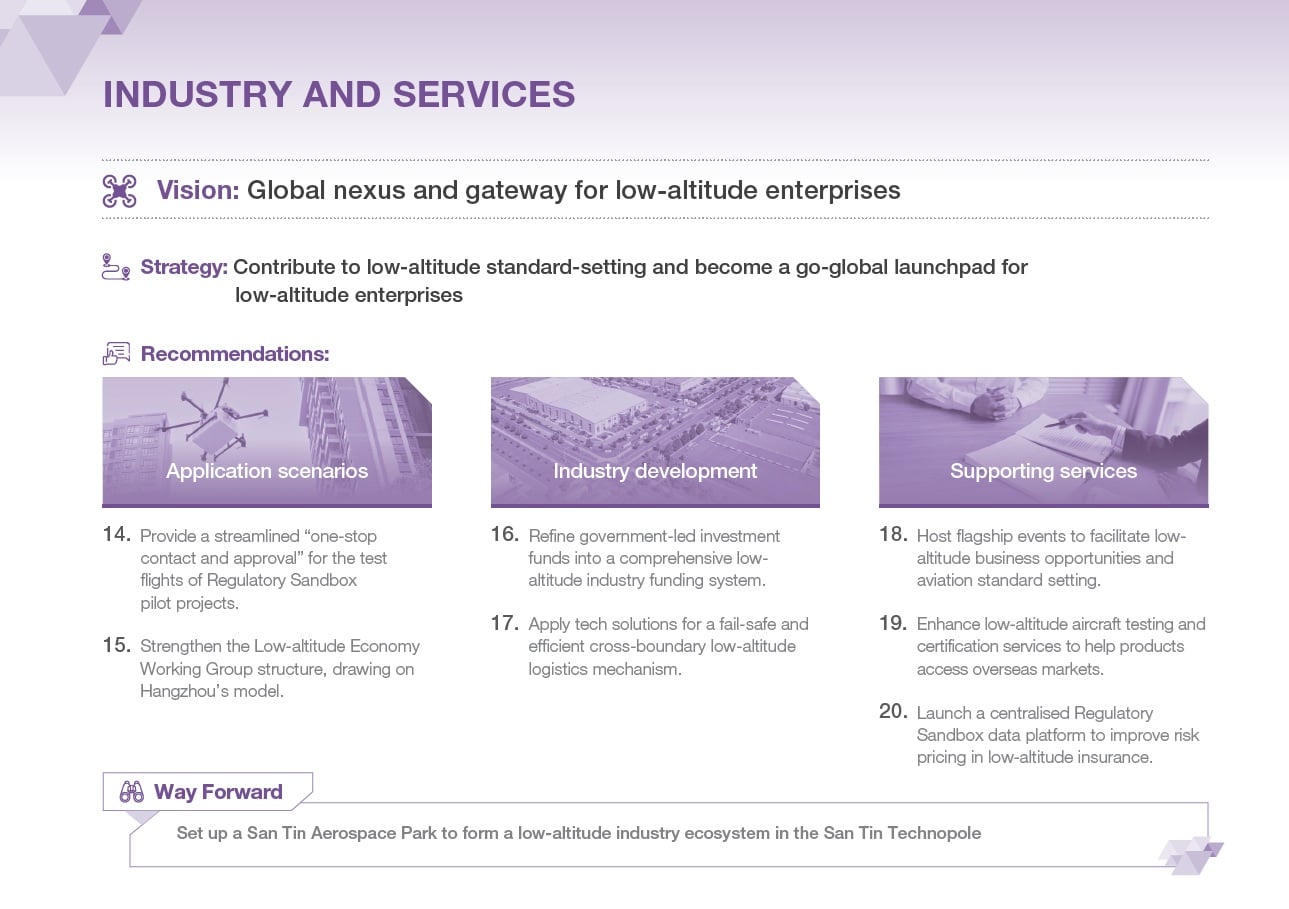
Industry and services are the mainstay for creating business value. To capitalise on this, Hong Kong should position itself as a global nexus and gateway for low-altitude enterprises. To do so, facilitating diverse application scenarios would bridge the gaps between project concepts and commercialisation. At the same time, promoting industry development through a comprehensive low-altitude industry funding system and regulatory framework would give a much-needed boost to turn business ideas into profitable ventures. Last but not least, broadening supporting services, e.g., events, testing, and insurance, would facilitate low-altitude business opportunities and aviation standard setting, placing Hong Kong as a go-global launchpad for low-altitude enterprises.




As a national strategic emerging industry, the low-altitude economy is set to reshape industries, services, and daily livelihoods, while injecting new impetus into Hong Kong’s economy. Our Hong Kong Foundation released its Taking Flight – Forging a Future for Hong Kong’s Low-Altitude Economy report, providing a comprehensive analysis of how Hong Kong could capture the cream of crop in the low-altitude economy.
Projected industry value added of the low-altitude economy to Hong Kong
To evaluate the potential economic contribution of the low-altitude economy to Hong Kong, this report has adopted a value-added approach. Accordingly, the low-altitude economy is broken down into four key segments: infrastructure development, education and research, application scenarios, and supporting services. With these assumptions applied, it is projected that the industry value added of the low-altitude economy in Hong Kong will reach approximately HK$ 350 billion in 2050, with the majority of value generated in supporting services.
A step-by-step approach to developing the low-altitude economy
Nevertheless, a step-by-step approach is required. This can be visualised as a pyramid framework constructed from multiple interconnected building blocks, grounded on infrastructure and regulations, followed by innovation and talent, and finally culminating in industry and services. In each layer, there is an overarching vision, a corresponding strategy, actionable recommendations, and the way forward.
Infrastructure and regulations
As the foundation for the low-altitude economy to “fly steady”, infrastructure and regulations can help shape Hong Kong into the world’s showcase of “Sky Urbanism”. Realising this, however, would require Hong Kong to support infrastructure development on the hardware side by using various implementation models, e.g., public-private partnership to install vertiports, charging facilities, and high-speed communication networks. For software, an airspace management system is needed to ensure the safe and efficient operation of low-altitude flying activities. Accordingly, laws and regulations need to be amended or created to facilitate the safe development of emerging low-altitude aircraft and flying activities.
Innovation and talent
Innovation and talent will enable the low-altitude economy “fly far”, building Hong Kong into an international talent hub for low-altitude technology. To this end, research and innovation in low-altitude technology need to be coordinated to focus on where they are most needed. Meanwhile, the workforce has to be upskilled via more rigorous requirements and a systematic curriculum in education and training. Moreover, talent acquisition policies also require timely review to attract low-altitude talent, positioning Hong Kong as a leader in next-generation low-altitude technologies.
Industry and services
Industry and services are the mainstay for creating business value. To capitalise on this, Hong Kong should position itself as a global nexus and gateway for low-altitude enterprises. To do so, facilitating diverse application scenarios would bridge the gaps between project concepts and commercialisation. At the same time, promoting industry development through a comprehensive low-altitude industry funding system and regulatory framework would give a much-needed boost to turn business ideas into profitable ventures. Last but not least, broadening supporting services, e.g., events, testing, and insurance, would facilitate low-altitude business opportunities and aviation standard setting, placing Hong Kong as a go-global launchpad for low-altitude enterprises.