










Central Bank Digital Currency: The Cornerstone of Digital Financial Infrastructure




Central Bank Digital Currency: The Cornerstone of Digital Financial Infrastructure

The coronavirus disease (COVID-19) has changed our traditional ways of life, with “contactless” becoming the latest buzzword, and business models becoming increasingly digitalised. The concept of Central Bank Digital Currency (CBDC) is thus growing in appeal to the general public.
CBDC is a legal tender issued by central banks in digital form. There are two types of CBDC: retail CBDC and wholesale CBDC. Retail CBDC is primarily designed for the public, including households and businesses, and is an innovation on the payment front (retail HKD CBDC is hereinafter referred to as “e-HKD”). Wholesale CBDC is primarily designed for financial institutions, with one primary function to provide a new method for interbank settlements, especially for cross-border settlements (wholesale HKD CBDC is hereinafter referred to as “w-CBDC HKD”).
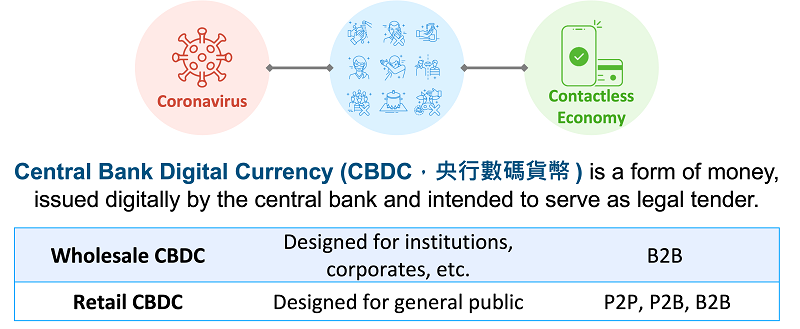
Currently, 86% of central banks worldwide now conducting CBDC related research. While the development of retail CBDC will bring convenience to the public, wholesale CBDC will serve as the core infrastructure for Hong Kong’s transformation from a traditional financial centre to a digital financial centre.
This report is structured into three different areas: retail CBDC, wholesale CBDC, and governance, offering seven recommendations in total. This report aims to explore how Hong Kong can take full advantage of the opportunities offered by CBDC and assume a leading role in the new era of digital finance.
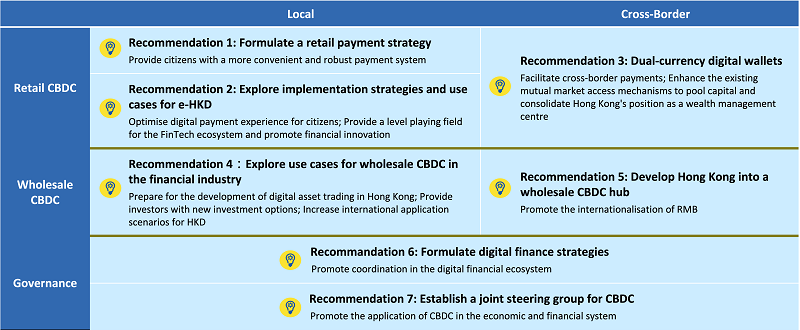
On the retail front, Hong Kong should formulate a comprehensive and overarching retail payment strategy to optimise the daily payment experience of citizens (Recommendation 1), explore local implementation strategies and use cases for e-HKD (Recommendation 2), and launch a dual-currency digital wallet for cross-border commuters that travel between the Mainland and Hong Kong (Recommendation 3).
On the wholesale front, Hong Kong should explore the application of wholesale CBDC in the financial industry to encourage process optimisation (Recommendation 4). Hong Kong should also aim to develop itself into a wholesale CBDC hub by connecting w-CBDC HKD with other CBDCs (Recommendation 5).
Lastly, in terms of governance, Hong Kong should formulate comprehensive digital finance strategies (Recommendation 6) and have the Hong Kong Monetary Authority set up a CBDC joint task force with the Financial Services and the Treasury Bureau (Recommendation 7).
A new era of digital finance is forthcoming, with CBDC being an integral part of this modern age. As the world’s traditional international financial centre, it is imperative for Hong Kong to make full use of its numerous advantages to facilitate the development and implementation of CBDC, with a view on ushering in a new era of digital finance for the city.




The coronavirus disease (COVID-19) has changed our traditional ways of life, with “contactless” becoming the latest buzzword, and business models becoming increasingly digitalised. The concept of Central Bank Digital Currency (CBDC) is thus growing in appeal to the general public.
CBDC is a legal tender issued by central banks in digital form. There are two types of CBDC: retail CBDC and wholesale CBDC. Retail CBDC is primarily designed for the public, including households and businesses, and is an innovation on the payment front (retail HKD CBDC is hereinafter referred to as “e-HKD”). Wholesale CBDC is primarily designed for financial institutions, with one primary function to provide a new method for interbank settlements, especially for cross-border settlements (wholesale HKD CBDC is hereinafter referred to as “w-CBDC HKD”).
Currently, 86% of central banks worldwide now conducting CBDC related research. While the development of retail CBDC will bring convenience to the public, wholesale CBDC will serve as the core infrastructure for Hong Kong’s transformation from a traditional financial centre to a digital financial centre.
This report is structured into three different areas: retail CBDC, wholesale CBDC, and governance, offering seven recommendations in total. This report aims to explore how Hong Kong can take full advantage of the opportunities offered by CBDC and assume a leading role in the new era of digital finance.
On the retail front, Hong Kong should formulate a comprehensive and overarching retail payment strategy to optimise the daily payment experience of citizens (Recommendation 1), explore local implementation strategies and use cases for e-HKD (Recommendation 2), and launch a dual-currency digital wallet for cross-border commuters that travel between the Mainland and Hong Kong (Recommendation 3).
On the wholesale front, Hong Kong should explore the application of wholesale CBDC in the financial industry to encourage process optimisation (Recommendation 4). Hong Kong should also aim to develop itself into a wholesale CBDC hub by connecting w-CBDC HKD with other CBDCs (Recommendation 5).
Lastly, in terms of governance, Hong Kong should formulate comprehensive digital finance strategies (Recommendation 6) and have the Hong Kong Monetary Authority set up a CBDC joint task force with the Financial Services and the Treasury Bureau (Recommendation 7).
A new era of digital finance is forthcoming, with CBDC being an integral part of this modern age. As the world’s traditional international financial centre, it is imperative for Hong Kong to make full use of its numerous advantages to facilitate the development and implementation of CBDC, with a view on ushering in a new era of digital finance for the city.