







Beyond Pilots: Hong Kong Hydrogen Energy Development Strategy




Beyond Pilots: Hong Kong Hydrogen Energy Development Strategy

Our Hong Kong Foundation (OHKF) released a policy research report titled “Beyond Pilots: Hong Kong Hydrogen Energy Development Strategy” (the Report). The Report puts forward 9 policy recommendations for hydrogen development in Hong Kong, exploring its strategic significance and how the city can leverage its unique advantages to develop high-value-added services.
The Report points out that energy supply has become a critical issue concerning economic lifelines and overall development security. The 15th Five-Year Plan explicitly identifies industries such as hydrogen energy as key areas for future development and new drivers of economic growth. Hydrogen serves as a relatively clean energy source that can help achieve the goal of carbon neutrality before 2050. Furthermore, developing hydrogen energy offers significant economic benefits, fostering a local industrial ecosystem that drives upstream and downstream supply chains, including transportation, testing, and certification sectors.
To realise this vision, the Report proposes key recommendations across four policy directions—Application, Services, Supply, and Governance—spanning short, medium, and long-term phases (see Appendix for full recommendations). These aim to propel the local hydrogen industry and proactively align with national macro-strategies:
1) Application
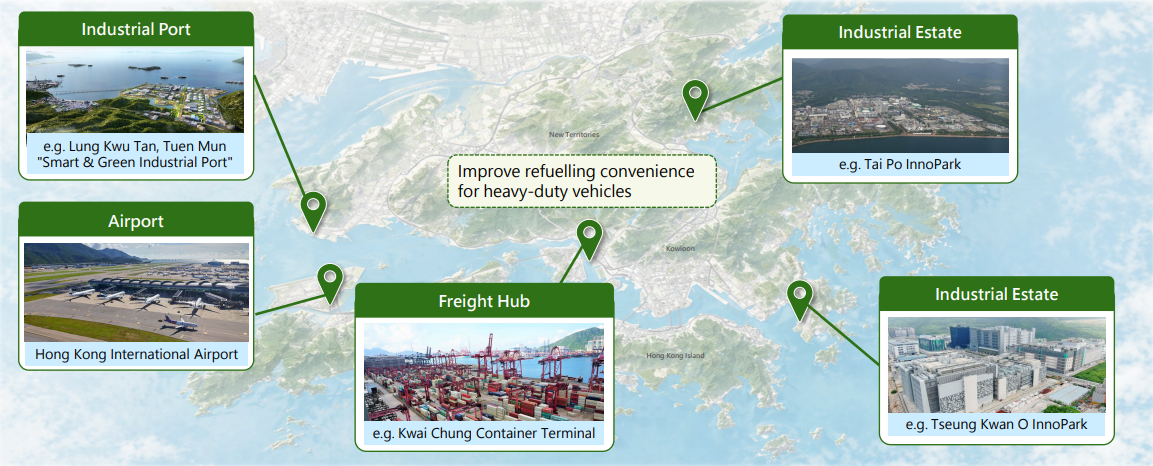
Prioritise Hydrogen Refuelling Stations in Heavy Vehicle Hubs: Hydrogen energy offers the advantages of “fast refuelling and high load capacity”, reducing refuelling time by over 75% compared to electric vehicles. Hydrogen demonstrates strong potential for heavy transport applications. To accelerate the implementation and popularisation of hydrogen energy in transportation, the report recommends prioritising the construction of hydrogen refuelling stations in heavy-vehicle hubs such as container terminals, industrial estates, and the airport. These locations have concentrated hydrogen demand, which will help improve infrastructure utilisation rates.
Provide policy incentives to encourage new districts to build hydrogen facilities: To encourage the application of hydrogen energy in new development areas such as the Northern Metropolis, the Government can adopt multiple policy incentives, including extending land lease terms and increasing winning bid probabilities. Specifically, if new traditional petrol stations or integrated energy stations commit to including hydrogen refuelling services, authorities may consider extending their land leases by an additional 3 to 7 years. Additionally, it is advised for the Government to include “provision of new energy facilities” as an evaluation criterion in relevant land or operation tenders, granting extra points to bidders who plan to add hydrogen facilities.
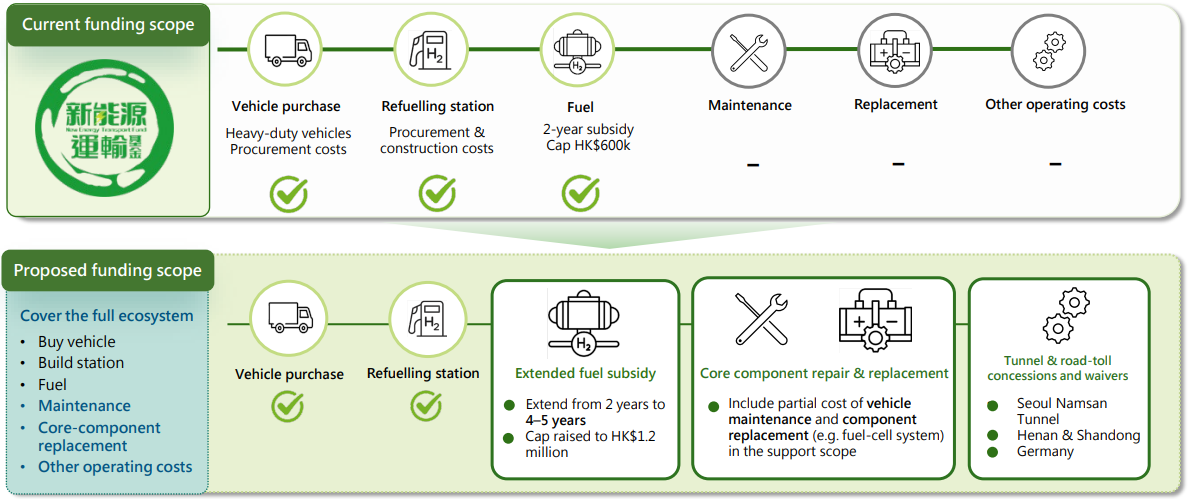
Expand the scope of the “New Energy Transport Fund”: The key to promoting hydrogen energy development lies in achieving widespread adoption of hydrogen vehicles. The existing “New Energy Transport Fund” already covers some hydrogen transport applications. To further improve support, the report recommends optimising the fund to expand its scope from purchasing hydrogen heavy vehicles, hydrogen fuel, and constructing refuelling stations to also cover vehicle maintenance, component replacement, and other operating costs. For example, authorities could draw on experiences from Chinese Mainland, South Korea, and Germany to study exemptions from tunnel and road tolls for hydrogen commercial vehicles or provide fee reductions for designated public facilities, thereby comprehensively reducing operational burdens on the industry. It is also suggested to extend the hydrogen fuel subsidy period from the current two years to four to five years, and raise the subsidy cap from HK$0.6 million to HK$1.2 million.
2) Services
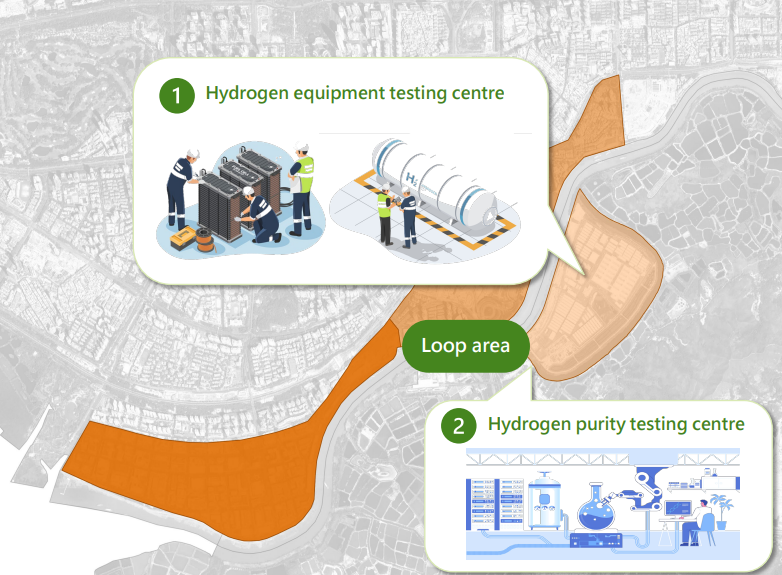
Cultivate local hydrogen energy quality testing capabilities: Hydrogen energy equipment and hydrogen gas (typically requiring purity ≥99.97%) must undergo strict periodic testing. However, Hong Kong currently lacks dedicated hydrogen energy testing facilities. In response, the Government could consider establishing a “Hydrogen Purity Testing Centre” and a “Hydrogen Energy Equipment Testing Centre” based in the Loop, Science Park, or existing testing and certification institutions. These centres would cover fuel cells, high-pressure containers, detectors, etc. If these local laboratories obtain international accreditation, they can leverage Hong Kong’s international credibility to attract Mainland and Asian enterprises to conduct testing and certification in Hong Kong, gradually building a “green new energy testing and certification services industry” in the city.
3) Supply
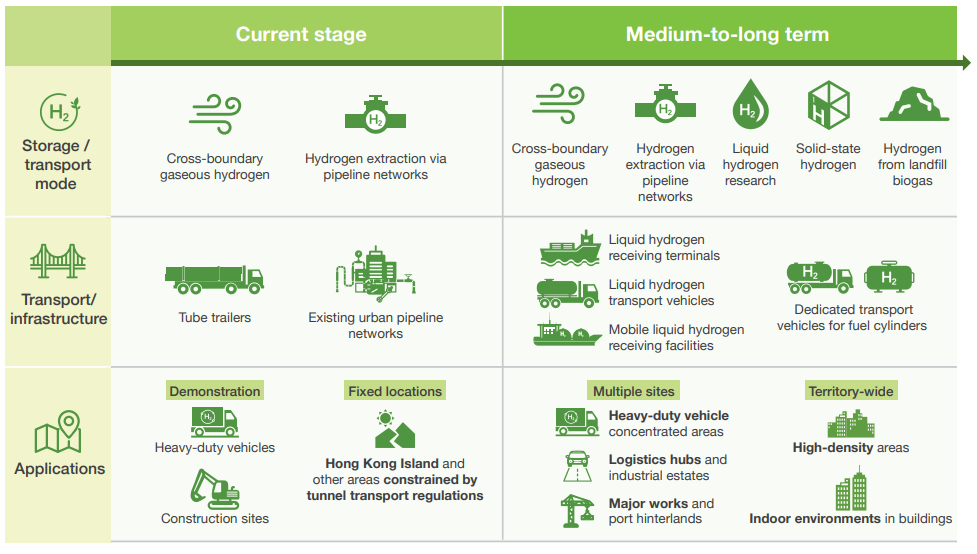
Comprehensive development of a diversified hydrogen energy supply network: The report recommends that Hong Kong expand its hydrogen supply network in phases. In the current stage, given the mature and extensive local town gas network with high hydrogen content (up to 49%), this existing advantage should be fully utilised. Priority should be given to hydrogen extraction from the town gas network at locations with concentrated hydrogen demand, reducing the need for cross-district road transport of high-pressure hydrogen. In the medium to long term, Hong Kong should conduct research on liquid hydrogen reception, storage, distribution, gasification processes, and safety operation guidelines for refuelling stations to help reduce long-distance and large-volume transport costs. At the same time, the potential of solid-state hydrogen technology and hydrogen production from landfill biogas should be actively explored to comprehensively broaden diversified hydrogen sources.
4) Governance
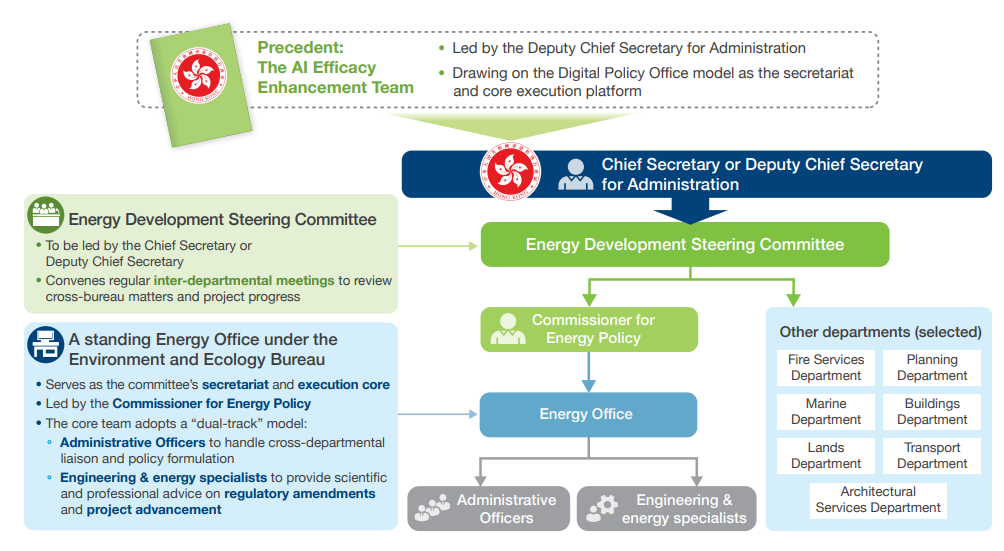
Strengthen cross-departmental coordination: Under Hong Kong’s goal of achieving carbon neutrality by 2050, continuously advancing energy transformation is crucial. Since hydrogen energy projects span multiple policy bureaux including Environment, Transport, and Development, the report recommends establishing an “Energy Steering Committee” led by the Chief Secretary for Administration or Deputy Chief Secretary for Administration. The Committee will be responsible for formulating short-, medium-, and long-term energy plans, supervising the implementation and commercialisation of new energy projects through high-level cross-bureau and cross-departmental meetings, and proactively aligning with national macro energy and industrial development strategies, such as the “15th Five-Year Plan” and the “Dual Carbon” targets. It is also suggested to establish a permanent “Energy Office” under the Environment and Ecology Bureau to serve as the secretariat and executive core of the Committee. The Office should adopt a “dual-track” structure: Administrative Officers (AOs) responsible for cross-departmental coordination and policy planning, complemented by engineering and energy professionals to provide scientific and expert advice on regulatory amendments and project implementation.




Our Hong Kong Foundation (OHKF) released a policy research report titled “Beyond Pilots: Hong Kong Hydrogen Energy Development Strategy” (the Report). The Report puts forward 9 policy recommendations for hydrogen development in Hong Kong, exploring its strategic significance and how the city can leverage its unique advantages to develop high-value-added services.
The Report points out that energy supply has become a critical issue concerning economic lifelines and overall development security. The 15th Five-Year Plan explicitly identifies industries such as hydrogen energy as key areas for future development and new drivers of economic growth. Hydrogen serves as a relatively clean energy source that can help achieve the goal of carbon neutrality before 2050. Furthermore, developing hydrogen energy offers significant economic benefits, fostering a local industrial ecosystem that drives upstream and downstream supply chains, including transportation, testing, and certification sectors.
To realise this vision, the Report proposes key recommendations across four policy directions—Application, Services, Supply, and Governance—spanning short, medium, and long-term phases (see Appendix for full recommendations). These aim to propel the local hydrogen industry and proactively align with national macro-strategies:
1) Application
Prioritise Hydrogen Refuelling Stations in Heavy Vehicle Hubs: Hydrogen energy offers the advantages of “fast refuelling and high load capacity”, reducing refuelling time by over 75% compared to electric vehicles. Hydrogen demonstrates strong potential for heavy transport applications. To accelerate the implementation and popularisation of hydrogen energy in transportation, the report recommends prioritising the construction of hydrogen refuelling stations in heavy-vehicle hubs such as container terminals, industrial estates, and the airport. These locations have concentrated hydrogen demand, which will help improve infrastructure utilisation rates.
Provide policy incentives to encourage new districts to build hydrogen facilities: To encourage the application of hydrogen energy in new development areas such as the Northern Metropolis, the Government can adopt multiple policy incentives, including extending land lease terms and increasing winning bid probabilities. Specifically, if new traditional petrol stations or integrated energy stations commit to including hydrogen refuelling services, authorities may consider extending their land leases by an additional 3 to 7 years. Additionally, it is advised for the Government to include “provision of new energy facilities” as an evaluation criterion in relevant land or operation tenders, granting extra points to bidders who plan to add hydrogen facilities.
Expand the scope of the “New Energy Transport Fund”: The key to promoting hydrogen energy development lies in achieving widespread adoption of hydrogen vehicles. The existing “New Energy Transport Fund” already covers some hydrogen transport applications. To further improve support, the report recommends optimising the fund to expand its scope from purchasing hydrogen heavy vehicles, hydrogen fuel, and constructing refuelling stations to also cover vehicle maintenance, component replacement, and other operating costs. For example, authorities could draw on experiences from Chinese Mainland, South Korea, and Germany to study exemptions from tunnel and road tolls for hydrogen commercial vehicles or provide fee reductions for designated public facilities, thereby comprehensively reducing operational burdens on the industry. It is also suggested to extend the hydrogen fuel subsidy period from the current two years to four to five years, and raise the subsidy cap from HK$0.6 million to HK$1.2 million.
2) Services
Cultivate local hydrogen energy quality testing capabilities: Hydrogen energy equipment and hydrogen gas (typically requiring purity ≥99.97%) must undergo strict periodic testing. However, Hong Kong currently lacks dedicated hydrogen energy testing facilities. In response, the Government could consider establishing a “Hydrogen Purity Testing Centre” and a “Hydrogen Energy Equipment Testing Centre” based in the Loop, Science Park, or existing testing and certification institutions. These centres would cover fuel cells, high-pressure containers, detectors, etc. If these local laboratories obtain international accreditation, they can leverage Hong Kong’s international credibility to attract Mainland and Asian enterprises to conduct testing and certification in Hong Kong, gradually building a “green new energy testing and certification services industry” in the city.
3) Supply
Comprehensive development of a diversified hydrogen energy supply network: The report recommends that Hong Kong expand its hydrogen supply network in phases. In the current stage, given the mature and extensive local town gas network with high hydrogen content (up to 49%), this existing advantage should be fully utilised. Priority should be given to hydrogen extraction from the town gas network at locations with concentrated hydrogen demand, reducing the need for cross-district road transport of high-pressure hydrogen. In the medium to long term, Hong Kong should conduct research on liquid hydrogen reception, storage, distribution, gasification processes, and safety operation guidelines for refuelling stations to help reduce long-distance and large-volume transport costs. At the same time, the potential of solid-state hydrogen technology and hydrogen production from landfill biogas should be actively explored to comprehensively broaden diversified hydrogen sources.
4) Governance
Strengthen cross-departmental coordination: Under Hong Kong’s goal of achieving carbon neutrality by 2050, continuously advancing energy transformation is crucial. Since hydrogen energy projects span multiple policy bureaux including Environment, Transport, and Development, the report recommends establishing an “Energy Steering Committee” led by the Chief Secretary for Administration or Deputy Chief Secretary for Administration. The Committee will be responsible for formulating short-, medium-, and long-term energy plans, supervising the implementation and commercialisation of new energy projects through high-level cross-bureau and cross-departmental meetings, and proactively aligning with national macro energy and industrial development strategies, such as the “15th Five-Year Plan” and the “Dual Carbon” targets. It is also suggested to establish a permanent “Energy Office” under the Environment and Ecology Bureau to serve as the secretariat and executive core of the Committee. The Office should adopt a “dual-track” structure: Administrative Officers (AOs) responsible for cross-departmental coordination and policy planning, complemented by engineering and energy professionals to provide scientific and expert advice on regulatory amendments and project implementation.