






Preparing for the 21st Century Globally Competitive Workforce—Industry-led Standards of Applied Education and Lifelong Learning




Preparing for the 21st Century Globally Competitive Workforce—Industry-led Standards of Applied Education and Lifelong Learning

Our Hong Kong Foundation has published its latest Education policy research report, “Preparing for the 21st Century Globally Competitive Workforce—Industry-led Standards of Applied Education and Lifelong Learning.”
The international competitiveness of Hong Kong’s youth has dwindled in the past few years. Confronted with the dual threats of Industry 4.0 and intensifying regional competition, Hong Kong’s education system must ensure that learners of all backgrounds are able to receive the education they need, in order to secure the city’s leading economic status in the future.
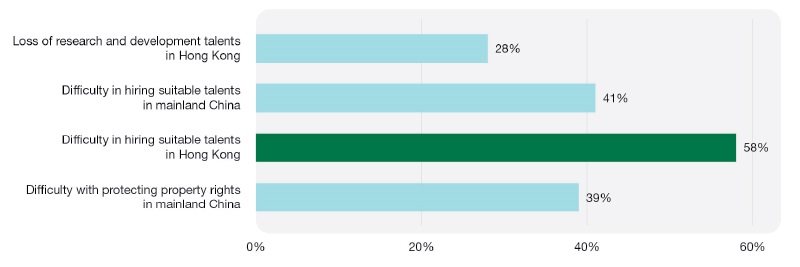
The IMD World Talent Ranking 2020 outlines that Hong Kong has been remiss in its investment and development of talents; its talent competitiveness ranking dropped from 10th in 2016 to 14th, while during the same period of time, Singapore’s ranking rose from 15th to 9th. This slip in talent competitiveness can be attributed to the discrepancy between human capital output from the education system and the in-demand skills required by employers: a research survey by the Federation of Hong Kong Industries shows that 58% of Hong Kong enterprises currently upgrading and restructuring their operations regard the lack of suitable local talents as their biggest obstacle.
In order to solve manpower shortages in the newest generation, countries around the world reached a consensus on the need to revamp their education systems; for instance, China’s "Outline of the Fourteenth Five-Year Plan for the National Economic and Social Development and the Long-Range Objectives Through the Year 2035" has summarised its commitment to invest in human capital, deepen industry school collaborations, and cultivate technically skilled talents.
In sharp contrast, Hong Kong’s education system has yet to fully support talent development, which hinders the progress of both society and the economy. As countries around the world scramble to bolster lifelong learning and help in-service practitioners upskill and reskill, Hong Kong has yet been unable to change public attitudes regarding continuing education. If Hong Kong is to create a work-study overpass that can integrate academic, applied, and industry qualifications, citizens must no longer view continuing education as merely a hobby.
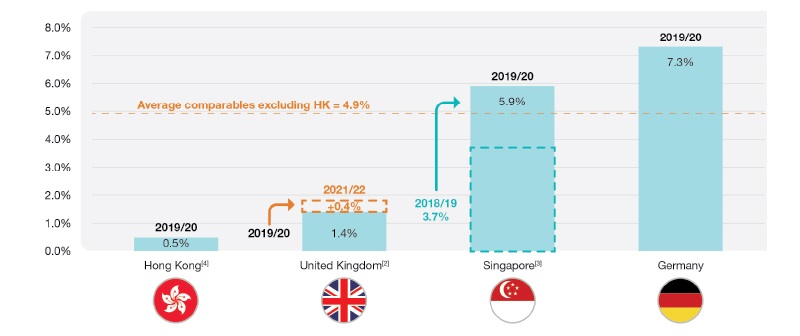
Hong Kong’s participation rate in continuing education has stalled at 20%, which is significantly lower than Singapore’s 49%. The Government spends only 0.5% of its total education expenditure on continuing education, which is only one-tenth of that averaged by countries like the United Kingdom, Germany, and Singapore To support Hong Kong’s sustainable development as a knowledge-based economy and cultivate talents equipped with tomorrow’s skills, our society needs to provide everyone with flexible and versatile continuing education opportunities.
OHKF hopes to shatter traditional perceptions of and approaches towards education, and explore how to further integrate academia and employers, build progression pathways that fully support study and employment, and develop policies that promote the development of diverse talents. This report puts forth 14 policy recommendations from the three interlinked fields of governance, accreditation, and funding. Components include: establishing a policy blueprint to implement industry led lifelong education that bridges economic, manpower, and skills development; offering diverse and flexible progression pathways through an industry integrated accreditation system; and building a targeted and future oriented funding mechanism to support lifelong learning for all.


Our Hong Kong Foundation has published its latest Education policy research report, “Preparing for the 21st Century Globally Competitive Workforce—Industry-led Standards of Applied Education and Lifelong Learning.”
The international competitiveness of Hong Kong’s youth has dwindled in the past few years. Confronted with the dual threats of Industry 4.0 and intensifying regional competition, Hong Kong’s education system must ensure that learners of all backgrounds are able to receive the education they need, in order to secure the city’s leading economic status in the future.
The IMD World Talent Ranking 2020 outlines that Hong Kong has been remiss in its investment and development of talents; its talent competitiveness ranking dropped from 10th in 2016 to 14th, while during the same period of time, Singapore’s ranking rose from 15th to 9th. This slip in talent competitiveness can be attributed to the discrepancy between human capital output from the education system and the in-demand skills required by employers: a research survey by the Federation of Hong Kong Industries shows that 58% of Hong Kong enterprises currently upgrading and restructuring their operations regard the lack of suitable local talents as their biggest obstacle.
In order to solve manpower shortages in the newest generation, countries around the world reached a consensus on the need to revamp their education systems; for instance, China’s "Outline of the Fourteenth Five-Year Plan for the National Economic and Social Development and the Long-Range Objectives Through the Year 2035" has summarised its commitment to invest in human capital, deepen industry school collaborations, and cultivate technically skilled talents.
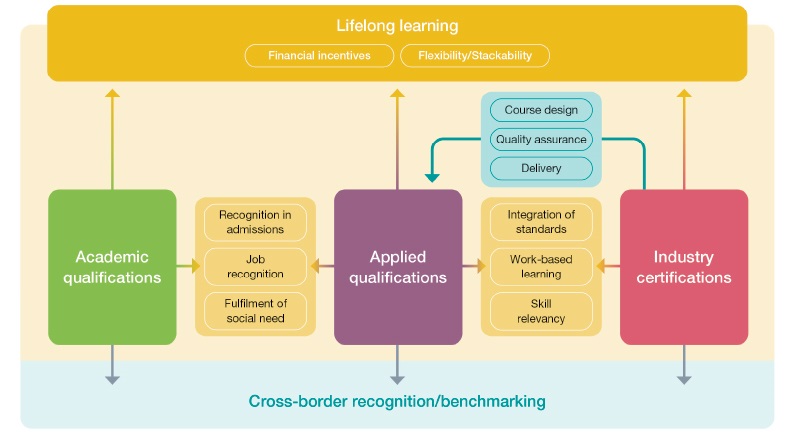
In sharp contrast, Hong Kong’s education system has yet to fully support talent development, which hinders the progress of both society and the economy. As countries around the world scramble to bolster lifelong learning and help in-service practitioners upskill and reskill, Hong Kong has yet been unable to change public attitudes regarding continuing education. If Hong Kong is to create a work-study overpass that can integrate academic, applied, and industry qualifications, citizens must no longer view continuing education as merely a hobby.
Hong Kong’s participation rate in continuing education has stalled at 20%, which is significantly lower than Singapore’s 49%. The Government spends only 0.5% of its total education expenditure on continuing education, which is only one-tenth of that averaged by countries like the United Kingdom, Germany, and Singapore To support Hong Kong’s sustainable development as a knowledge-based economy and cultivate talents equipped with tomorrow’s skills, our society needs to provide everyone with flexible and versatile continuing education opportunities.
OHKF hopes to shatter traditional perceptions of and approaches towards education, and explore how to further integrate academia and employers, build progression pathways that fully support study and employment, and develop policies that promote the development of diverse talents. This report puts forth 14 policy recommendations from the three interlinked fields of governance, accreditation, and funding. Components include: establishing a policy blueprint to implement industry led lifelong education that bridges economic, manpower, and skills development; offering diverse and flexible progression pathways through an industry integrated accreditation system; and building a targeted and future oriented funding mechanism to support lifelong learning for all.