







Professor Lawrence J. Lau Shares Expert Views on ‘The Impacts of the Social Unrest and the COVID-19 Epidemic on the Hong Kong Economy, and the Way Forward’





Professor Lawrence J. Lau Shares Expert Views on ‘The Impacts of the Social Unrest and the COVID-19 Epidemic on the Hong Kong Economy, and the Way Forward’

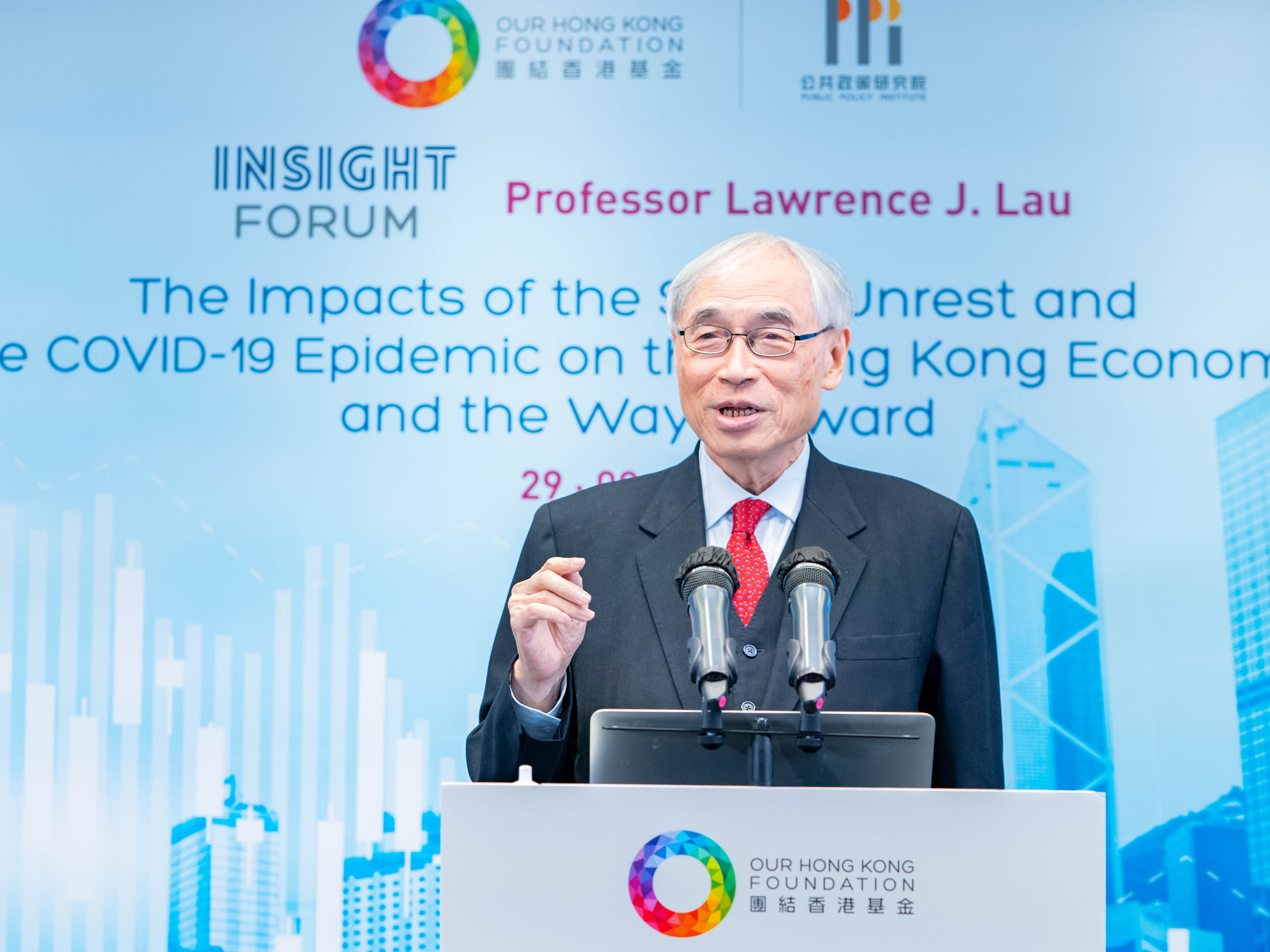
The social unrest and Covid-19 epidemic have dealt a double blow to the Hong Kong economy since Q2 2019, with the consequential recession expected to deepen in 2020. At the ninth ‘INSIGHT FORUM’ webinar organised by the Our Hong Kong Foundation (OHKF), Professor Lawrence J. Lau, Ralph and Claire Landau Professor of Economics, Lau Chor Tak Institute of Global Economics and Finance, The Chinese University of Hong Kong, shared expert views on how the Hong Kong economy may recover to positive growth in 2021. He also shed light on how the HKSAR Government can take lead in increasing aggregate demand through suitable and timely public investment in some identified areas.
Hong Kong Economy May Recover to Positive Growth in 2021
Professor Lau explained that the social unrest in 2019 caused a loss of real GDP of 3.7% in 2019 and that the Covid-19 epidemic caused a loss of 6.4% to real GDP up to the first half of 2020. For 2020 as a whole, the total loss due to the Covid-19 epidemic may be estimated to be 11.4% of real GDP.
Despite lingering Covid-19 conditions, the Hong Kong economy may recover to positive growth in 2021, predicted by Professor Lau. However, the economic recovery is likely to be slow unless the Government takes the lead in increasing aggregate demand through suitable and timely increases in public investment expenditures.
Cash Distribution of HK$10,000 and the Employment Support Scheme are Most Helpful
Professor Lau believed that the various measures already undertaken by the Government, such as the distribution of HK$10,000 to each and every resident and the Employment Support Scheme (ESS), have been most helpful because they inject purchasing power into the economic system immediately and contribute to maintaining employment.
However, they alone are not enough to sustain aggregate demand, while businesses and households may be loath to spend when future economic prospects are uncertain.
Aggregate Demand Needs to be Replenished through Public Investment Expenditures
Therefore, aggregate demand needs to be replenished through public investment expenditures to create domestic GDP and employment directly. Professor Lau emphasised that an important consideration is whether these public investment projects can be readily implemented with local labour and resources and relatively low import requirements.
He suggested several possible areas for public investment, like retrofitting of all public buildings to make them energy-efficient, ranging from installation of solar panels, replacement of antiquated air conditioning systems, and use of double-glazed windows. With retrofitting, the public buildings can be made epidemic-safe through automated doors, voice-activated lifts, and even automated temperature-sensitive surveillance cameras.
Secondly, building more hospitals with up-to-date surgical and intensive-care facilities, and better elderly care homes, will be also a good investment to meet the needs of a rapidly ageing population.
Thirdly, during the Covid-19 epidemic, many governmental functions have been executed online and through video conferencing. In order to further facilitate the use of e-Government, an attempt should also be made to digitise all old government documents including birth, death, marriage and divorce records, and property deeds.
Moreover, the Government should consider repairing and restoring government-owned public rental housing units that have deteriorated over the years; and also the largely antiquated underground sewage systems to prevent frequent flooding on the one hand, and becoming a potential source of transmission of bacteria and viruses on the other.
Time for the HKSAR Government to Act Now
Professor Lau foresaw some lead time before any public investment plan becomes a reality. But the mere announcement of the plans by the Government will get the private sector to begin thinking and working, well before the tenders are out and contracts are awarded. He noted that the time for the Government to act is now!


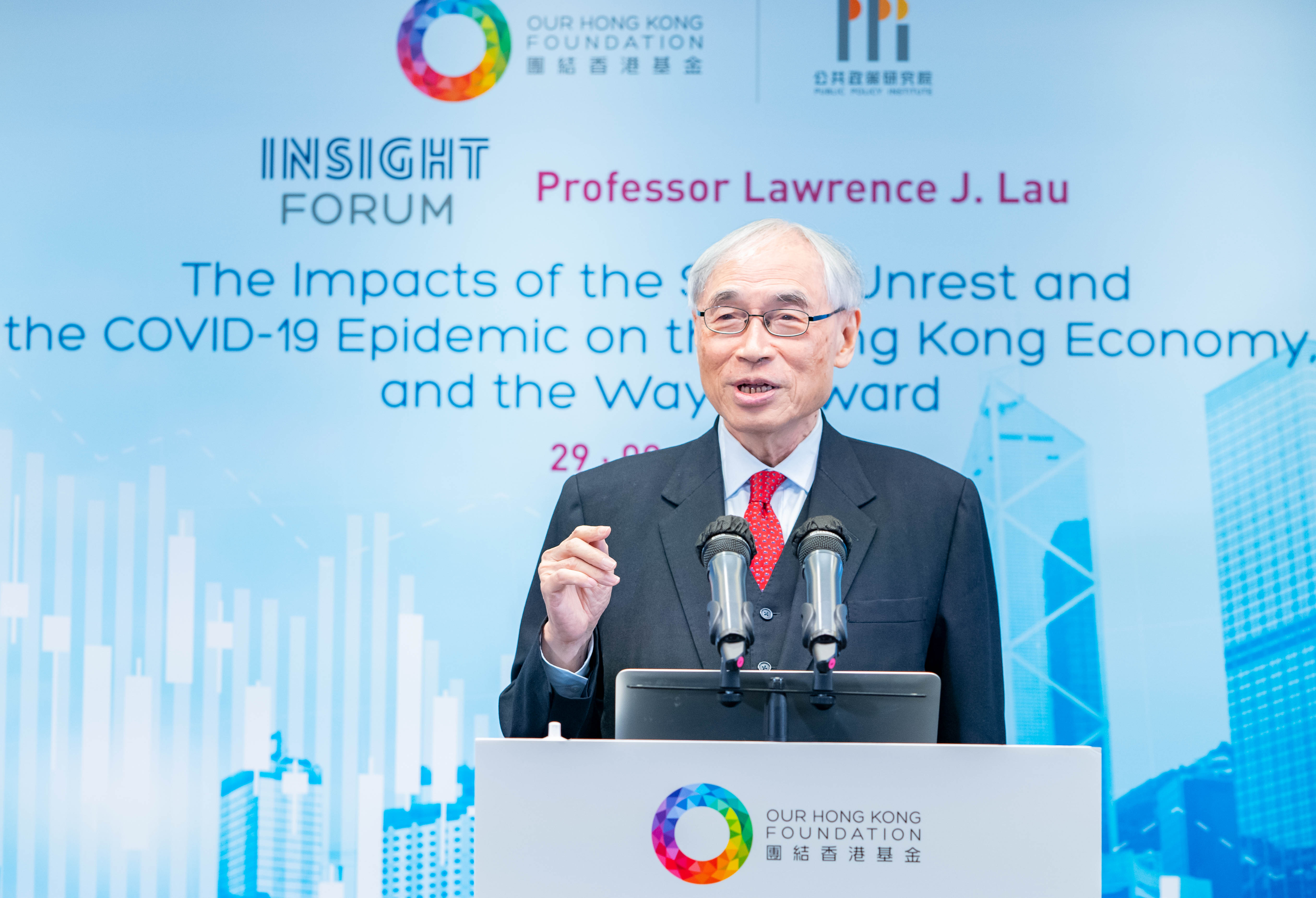
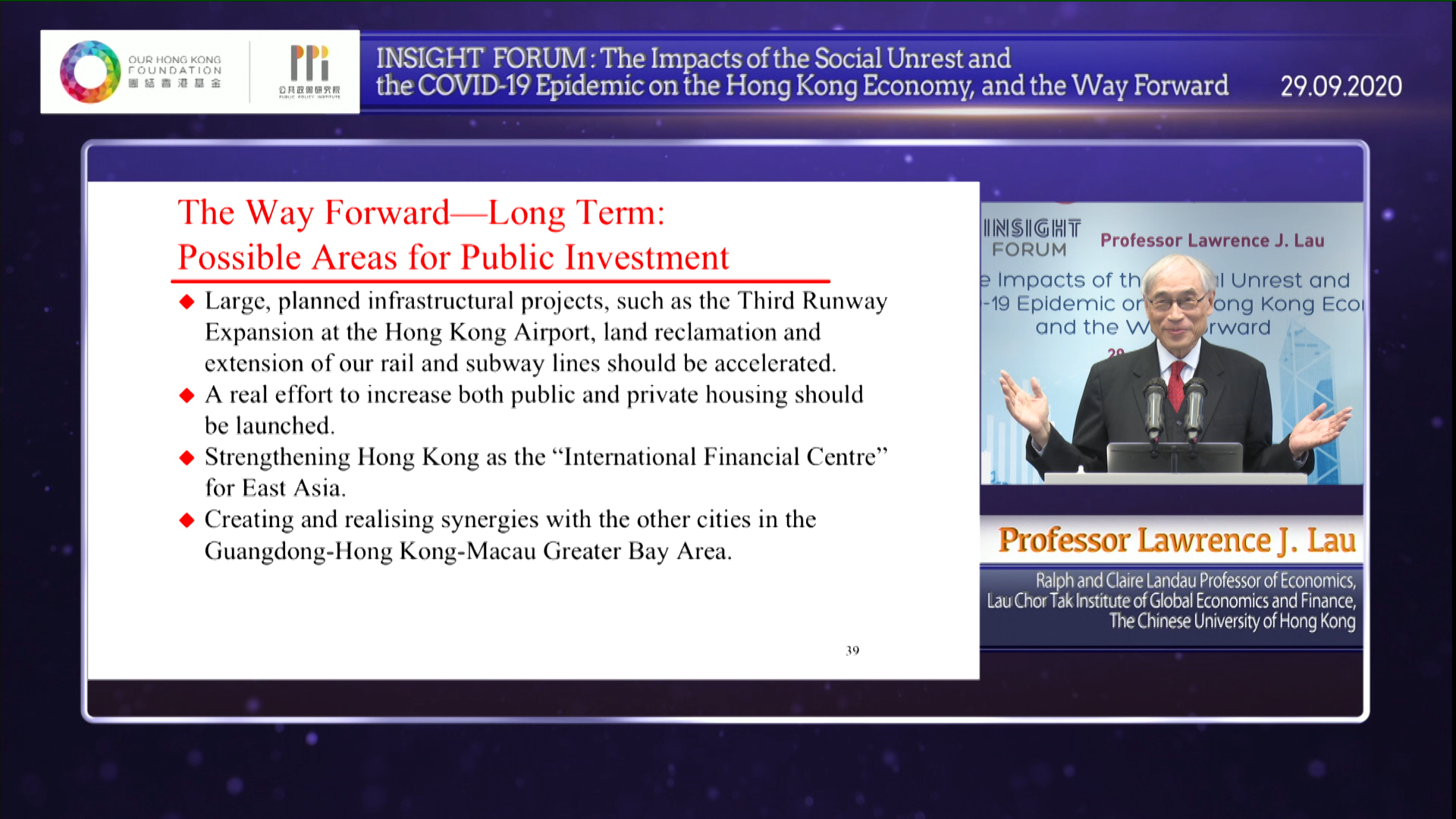







The social unrest and Covid-19 epidemic have dealt a double blow to the Hong Kong economy since Q2 2019, with the consequential recession expected to deepen in 2020. At the ninth ‘INSIGHT FORUM’ webinar organised by the Our Hong Kong Foundation (OHKF), Professor Lawrence J. Lau, Ralph and Claire Landau Professor of Economics, Lau Chor Tak Institute of Global Economics and Finance, The Chinese University of Hong Kong, shared expert views on how the Hong Kong economy may recover to positive growth in 2021. He also shed light on how the HKSAR Government can take lead in increasing aggregate demand through suitable and timely public investment in some identified areas.
Hong Kong Economy May Recover to Positive Growth in 2021
Professor Lau explained that the social unrest in 2019 caused a loss of real GDP of 3.7% in 2019 and that the Covid-19 epidemic caused a loss of 6.4% to real GDP up to the first half of 2020. For 2020 as a whole, the total loss due to the Covid-19 epidemic may be estimated to be 11.4% of real GDP.
Despite lingering Covid-19 conditions, the Hong Kong economy may recover to positive growth in 2021, predicted by Professor Lau. However, the economic recovery is likely to be slow unless the Government takes the lead in increasing aggregate demand through suitable and timely increases in public investment expenditures.
Cash Distribution of HK$10,000 and the Employment Support Scheme are Most Helpful
Professor Lau believed that the various measures already undertaken by the Government, such as the distribution of HK$10,000 to each and every resident and the Employment Support Scheme (ESS), have been most helpful because they inject purchasing power into the economic system immediately and contribute to maintaining employment.
However, they alone are not enough to sustain aggregate demand, while businesses and households may be loath to spend when future economic prospects are uncertain.
Aggregate Demand Needs to be Replenished through Public Investment Expenditures
Therefore, aggregate demand needs to be replenished through public investment expenditures to create domestic GDP and employment directly. Professor Lau emphasised that an important consideration is whether these public investment projects can be readily implemented with local labour and resources and relatively low import requirements.
He suggested several possible areas for public investment, like retrofitting of all public buildings to make them energy-efficient, ranging from installation of solar panels, replacement of antiquated air conditioning systems, and use of double-glazed windows. With retrofitting, the public buildings can be made epidemic-safe through automated doors, voice-activated lifts, and even automated temperature-sensitive surveillance cameras.
Secondly, building more hospitals with up-to-date surgical and intensive-care facilities, and better elderly care homes, will be also a good investment to meet the needs of a rapidly ageing population.
Thirdly, during the Covid-19 epidemic, many governmental functions have been executed online and through video conferencing. In order to further facilitate the use of e-Government, an attempt should also be made to digitise all old government documents including birth, death, marriage and divorce records, and property deeds.
Moreover, the Government should consider repairing and restoring government-owned public rental housing units that have deteriorated over the years; and also the largely antiquated underground sewage systems to prevent frequent flooding on the one hand, and becoming a potential source of transmission of bacteria and viruses on the other.
Time for the HKSAR Government to Act Now
Professor Lau foresaw some lead time before any public investment plan becomes a reality. But the mere announcement of the plans by the Government will get the private sector to begin thinking and working, well before the tenders are out and contracts are awarded. He noted that the time for the Government to act is now!