






OHKF Releases Low-Altitude Economy Policy Proposals




OHKF Releases Low-Altitude Economy Policy Proposals

Developing the San Tin Aerospace Park Technology Park
Pilot Demonstration Zone to Build a Low-Altitude Ecosystem
(4 September 2025, Hong Kong) Our Hong Kong Foundation (OHKF) released its latest research report entitled Taking Flight — Forging a Future for Hong Kong’s Low-Altitude Economy today. As a national strategic emerging industry, the low-altitude economy (LAE) encompasses economic activities that take place in airspace below 1,000 metres, and is poised to inject new impetus into Hong Kong’s economy.
However, with its relatively small population and land size, such potential will be limited unless Hong Kong moves beyond being a mere adopter of technology. Based on the latest publicly available data, the industry value added of the LAE in Hong Kong will reach approximately HK$ 350 billion in 2050, with the majority of value generated in supporting services. In this light, OHKF advocates that the city should capture the cream of the crop in the LAE by specialising in high value-added services, leveraging its repertoire of world-class financial, legal, and professional expertise.
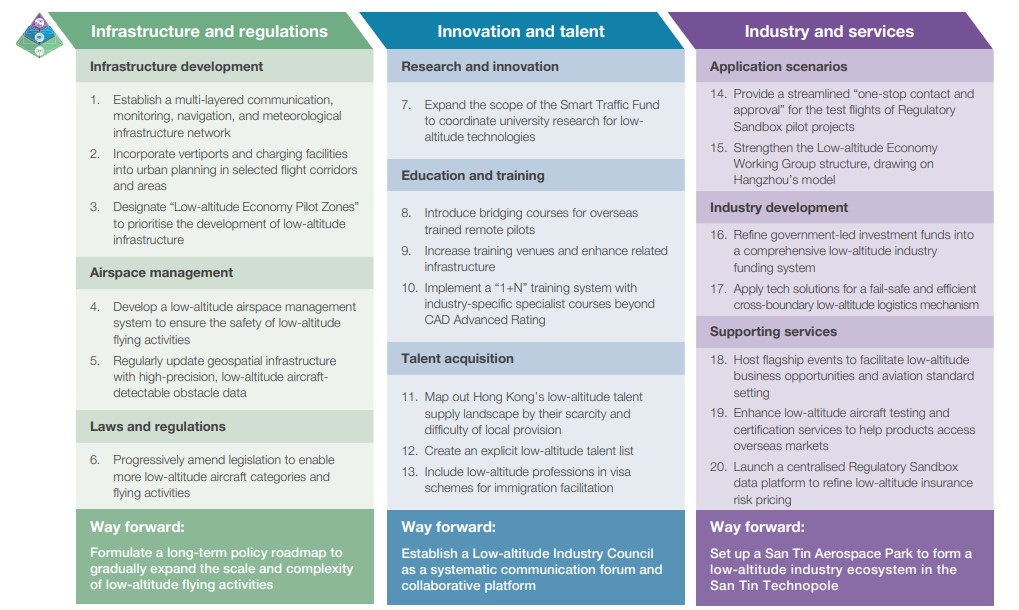
Grounded on infrastructure and regulations, followed by innovation and talent, and finally culminating in industry and services, the report outlined a three-layer pyramid framework for developing the LAE in Hong Kong. In total, OHKF put forward 20 actionable recommendations, with a way forward for each layer (Figure 1):
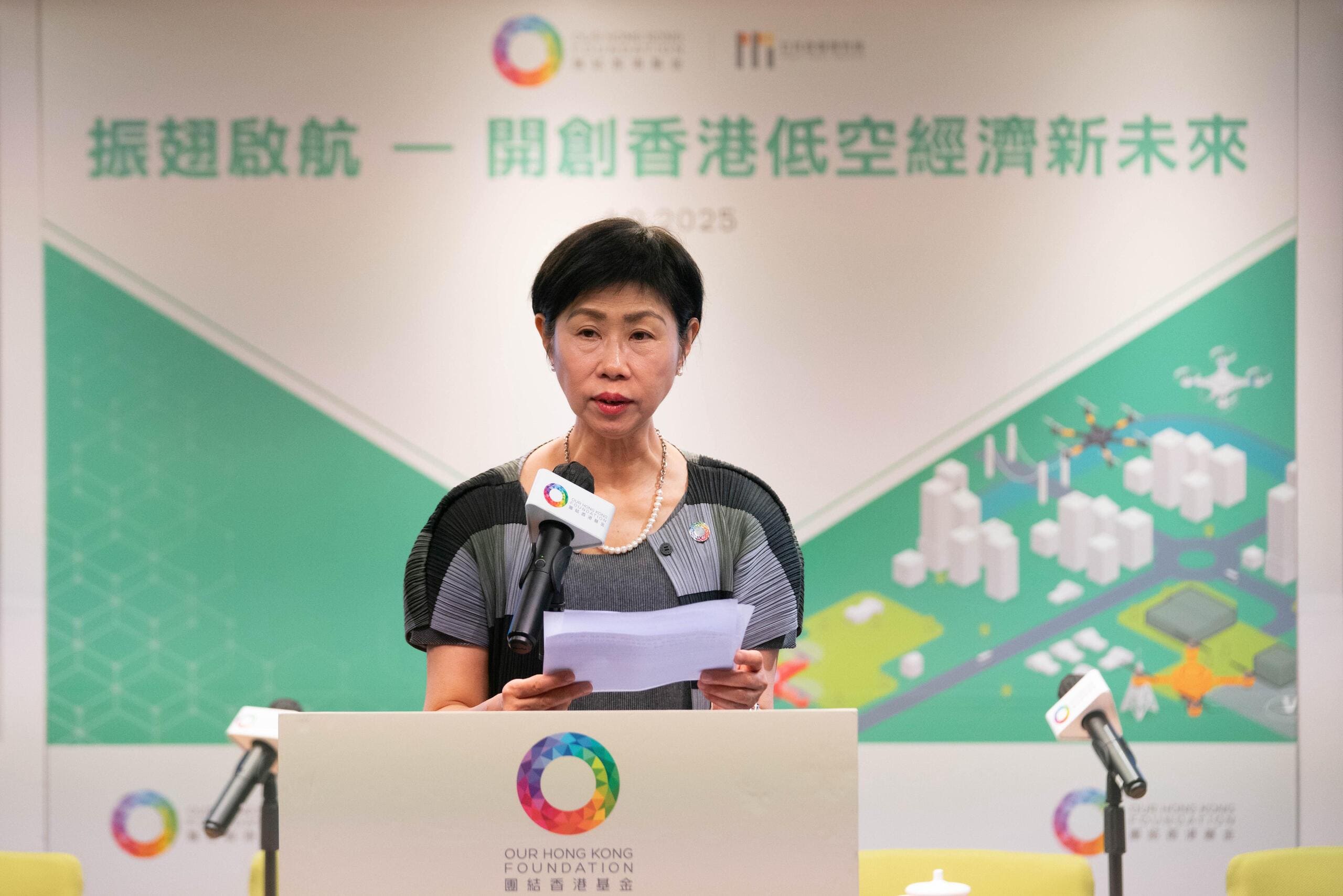
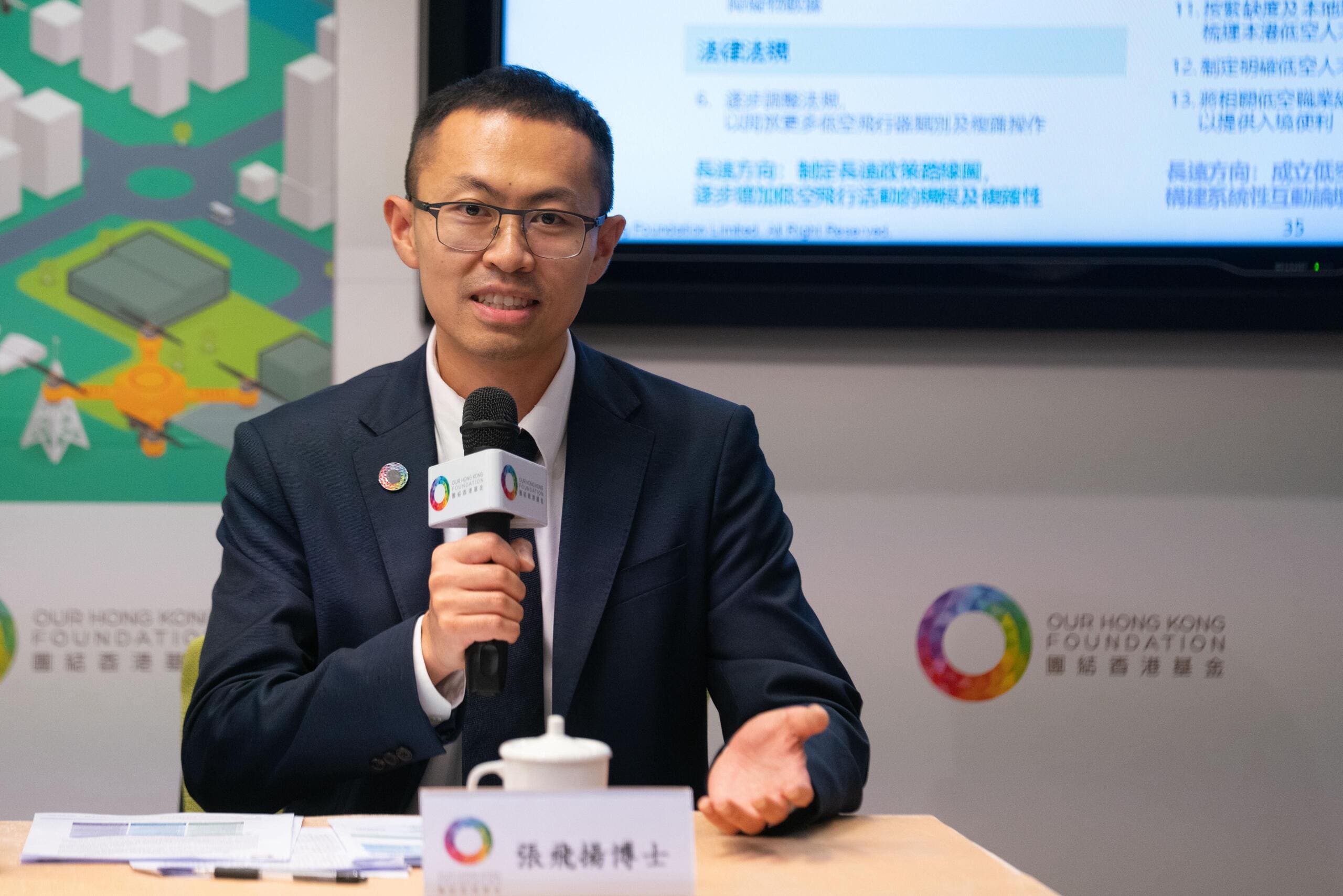
President of Our Hong Kong Foundation Dr Jane Lee said: “The significance of the LAE is underlined by its inclusion in the Central Government’s Report on the Work of the Government in 2024 and 2025, the establishment of the Department of Emerging Air Economy under the National Development and Reform Commission in late 2024, and it being one of the key policy initiatives announced in the Chief Executive’s 2024 Policy Address. In the face of this once-in-a-lifetime opportunity, Hong Kong has both the responsibility and the capability to play a significant role on the global stage of the LAE.”
1. Infrastructure and regulations
For the low-altitude economy to “fly far”, it must first “fly steady”. Endowed with a unique and dense built environment, Hong Kong has the potential to become the world’s showcase of “Sky Urbanism” if it can ensure the safe operation of low-altitude flying activities at scale. Realising this, however, would require the Government to plan for forward-looking low-altitude infrastructure and supportive regulations with a clear roadmap. Key recommendations include:
Designate “Low-altitude Economy Pilot Zones" to prioritise the development of low-altitude infrastructure: Besides facilitating the validation of low-altitude infrastructure, these Pilot Zones would allow the Government to further test and demonstrate the potential of diverse themes and use cases with more flexibility than the Regulatory Sandbox pilot projects, while maintaining risk levels controllable.
Develop a low-altitude airspace management system to ensure the safety of low-altitude flying activities: Such a system should encompass three inseparable functions, namely (i) risk management and (ii) authorisation for non-recreational flying activities, as well as (iii) airspace control for all flying activities.
2. Innovation and talent
Having been well-placed to “fly steady”, attention should turn towards how to “fly far”. To this end, Hong Kong should become an international talent hub for low-altitude technology. Transforming this vision into reality would require Hong Kong to invest in innovation and talent to propel the development of next-generation low-altitude technologies, ensuring that it not only participates, but also leads in this emerging sector. Key recommendations include:
Expand the scope of the Smart Traffic Fund to coordinate university research for low-altitude technologies: Such expansion beyond the current vehicle-related topics would leverage such a ready-made model and resources on hand to guide and accelerate research in areas where it is most needed to develop the LAE in Hong Kong.
Introduce bridging courses for overseas trained remote pilots: To enhance the current overseas certification recognition mechanism, such courses should target areas in Hong Kong’s curriculum that are not covered in overseas training programmes, ensuring that overseas-trained remote pilots acquire sufficient competencies for safe operation in Hong Kong.
Implement a "1+N" training system with industry-specific specialist courses beyond CAD Advanced Rating: Similar to professions such as engineering, LAE applications entail specialised skill sets beyond generic flying abilities, which calls for industry-specific specialist courses that are tailored for specific application scenarios.
Establish a Low-altitude Industry Council as a systematic communication forum and collaborative platform: This would be a high-level, industry-centric, and cross-sector forum represented by industry stakeholders, research and training organisations, and government bodies, with a mission to foster government-industry-academia-research collaboration.
3. Industry and services
The low-altitude economy’s path to “fly far” would ultimately lead Hong Kong to new revenue streams. To fully capitalise these, Hong Kong should position itself as a global nexus and gateway for low-altitude enterprises. Nevertheless, for it to draw the start-ups and enterprises that will fuel this sector, it needs to contribute to low-altitude standard-setting and become a go-global launchpad for low-altitude enterprises. Key recommendations include:
Host flagship events to facilitate low-altitude business opportunities and aviation standard setting: Referencing Canada Montreal’s status as the standard hub of international civil aviation, the Government should scale up local business events to gather businesses and attract global low-altitude aviation standard-setting expert groups to convene in the city.
Enhance low-altitude aircraft testing and certification services to help products access overseas markets: The Hong Kong Accreditation Service should conduct a comprehensive review to identify the missing elements and introduce relevant accreditation for low-altitude aircraft. This would further strengthen Hong Kong as an international testing and certification hub.
Set up a San Tin Aerospace Park to form a low-altitude industry ecosystem in the San Tin Technopole: As a signature landmark to demonstrate Hong Kong’s tangible commitment to the low-altitude economy, this is where world-class infrastructure converges to realise the low-altitude economy’s business potential, where there are unbounded opportunities for innovation and cross-fertilisation, and where you will see a vibrant low-altitude industry ecosystem with an eclectic mix of leading global enterprises.
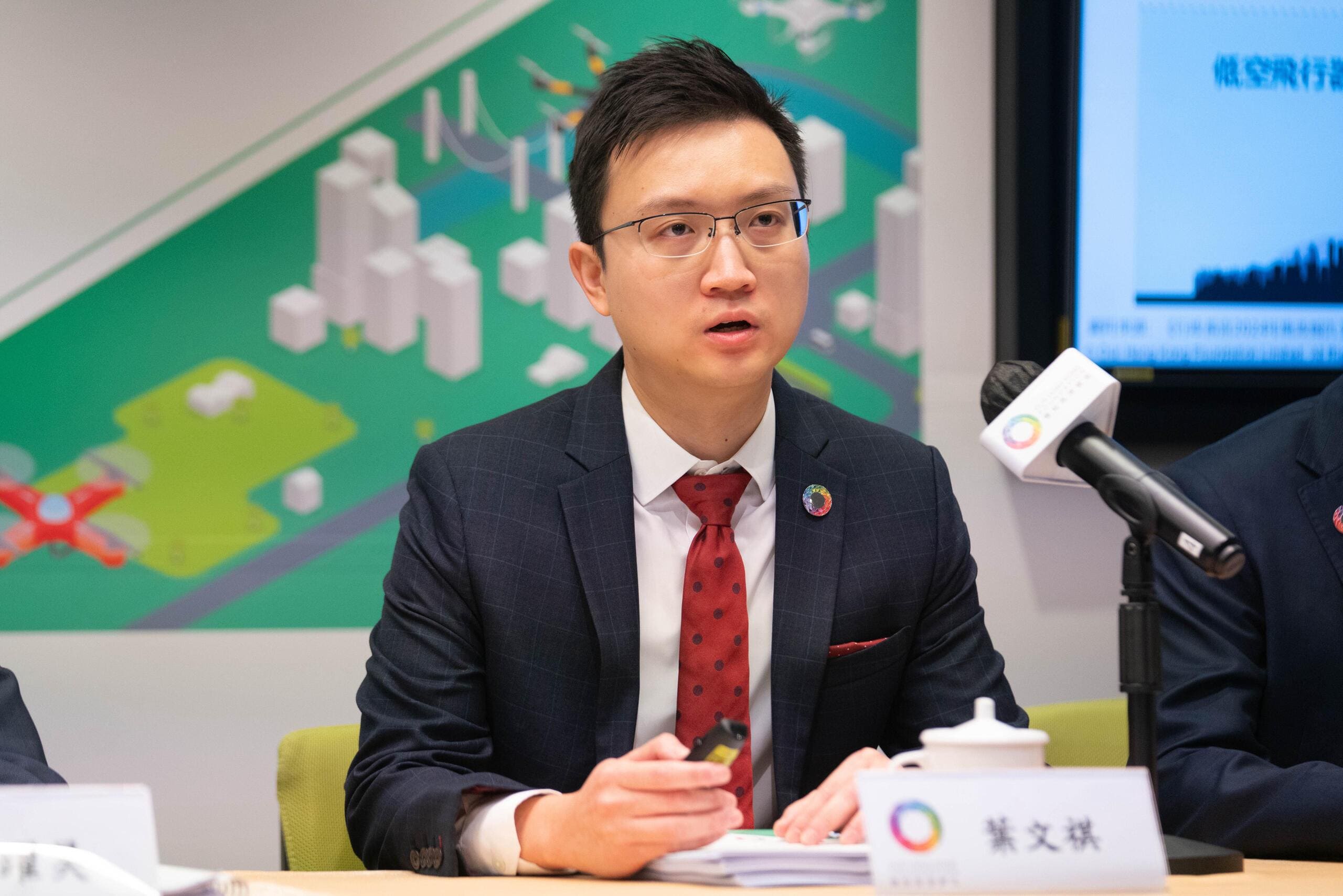
Vice President of Our Hong Kong Foundation and Executive Director of Public Policy Institute, Mr Ryan Ip, remarked: “Hong Kong is on the cusp of a transformative shift as it embraces the LAE, a rapidly growing sector poised to revolutionise industries, reshape urban landscapes and redefine modern lifestyle. Nevertheless, Hong Kong should not merely aim to participate, but to pioneer – not just to follow and adopt technology, but to forge the way by pushing the boundaries of technology. Through the process, by leveraging the city’s world-class financial, legal, and professional expertise in delivering high value-added services, it stands to capture the cream of the crop in the LAE.”
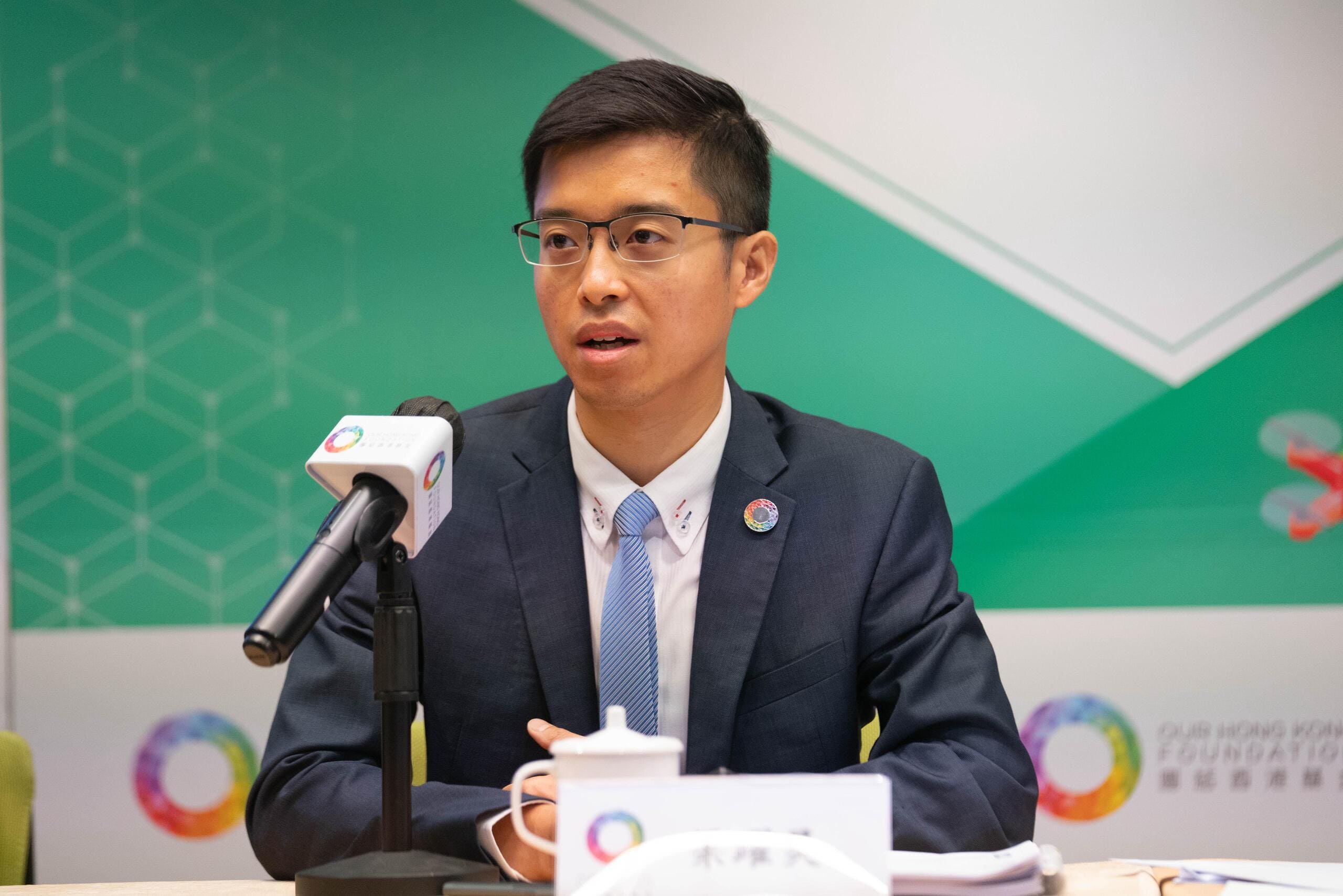
Head of Land & Housing of Our Hong Kong Foundation, Mr Jason Leung, commented: “The LAE is a unique opportunity for Hong Kong to secure a strategic perch as it pioneers a new economic engine powered by innovation and technology. Nevertheless, before the LAE can reach new heights, it must be grounded on rigorous safety standards and public trust. This report, therefore, laid out a clear and methodical approach built upon a three-layer pyramid framework, with an overarching vision, a corresponding strategy, actionable recommendations, and the way forward in each layer to advance the LAE in Hong Kong.”
-
Taking Flight — Forging a Future for Hong Kong’s Low-Altitude Economy
Full Report: https://bit.ly/420JwgU
Executive Summary: https://bit.ly/4p1YGwn




Developing the San Tin Aerospace Park Technology Park
Pilot Demonstration Zone to Build a Low-Altitude Ecosystem
(4 September 2025, Hong Kong) Our Hong Kong Foundation (OHKF) released its latest research report entitled Taking Flight — Forging a Future for Hong Kong’s Low-Altitude Economy today. As a national strategic emerging industry, the low-altitude economy (LAE) encompasses economic activities that take place in airspace below 1,000 metres, and is poised to inject new impetus into Hong Kong’s economy.
However, with its relatively small population and land size, such potential will be limited unless Hong Kong moves beyond being a mere adopter of technology. Based on the latest publicly available data, the industry value added of the LAE in Hong Kong will reach approximately HK$ 350 billion in 2050, with the majority of value generated in supporting services. In this light, OHKF advocates that the city should capture the cream of the crop in the LAE by specialising in high value-added services, leveraging its repertoire of world-class financial, legal, and professional expertise.
Grounded on infrastructure and regulations, followed by innovation and talent, and finally culminating in industry and services, the report outlined a three-layer pyramid framework for developing the LAE in Hong Kong. In total, OHKF put forward 20 actionable recommendations, with a way forward for each layer (Figure 1):
President of Our Hong Kong Foundation Dr Jane Lee said: “The significance of the LAE is underlined by its inclusion in the Central Government’s Report on the Work of the Government in 2024 and 2025, the establishment of the Department of Emerging Air Economy under the National Development and Reform Commission in late 2024, and it being one of the key policy initiatives announced in the Chief Executive’s 2024 Policy Address. In the face of this once-in-a-lifetime opportunity, Hong Kong has both the responsibility and the capability to play a significant role on the global stage of the LAE.”
1. Infrastructure and regulations
For the low-altitude economy to “fly far”, it must first “fly steady”. Endowed with a unique and dense built environment, Hong Kong has the potential to become the world’s showcase of “Sky Urbanism” if it can ensure the safe operation of low-altitude flying activities at scale. Realising this, however, would require the Government to plan for forward-looking low-altitude infrastructure and supportive regulations with a clear roadmap. Key recommendations include:
Designate “Low-altitude Economy Pilot Zones" to prioritise the development of low-altitude infrastructure: Besides facilitating the validation of low-altitude infrastructure, these Pilot Zones would allow the Government to further test and demonstrate the potential of diverse themes and use cases with more flexibility than the Regulatory Sandbox pilot projects, while maintaining risk levels controllable.
Develop a low-altitude airspace management system to ensure the safety of low-altitude flying activities: Such a system should encompass three inseparable functions, namely (i) risk management and (ii) authorisation for non-recreational flying activities, as well as (iii) airspace control for all flying activities.
2. Innovation and talent
Having been well-placed to “fly steady”, attention should turn towards how to “fly far”. To this end, Hong Kong should become an international talent hub for low-altitude technology. Transforming this vision into reality would require Hong Kong to invest in innovation and talent to propel the development of next-generation low-altitude technologies, ensuring that it not only participates, but also leads in this emerging sector. Key recommendations include:
Expand the scope of the Smart Traffic Fund to coordinate university research for low-altitude technologies: Such expansion beyond the current vehicle-related topics would leverage such a ready-made model and resources on hand to guide and accelerate research in areas where it is most needed to develop the LAE in Hong Kong.
Introduce bridging courses for overseas trained remote pilots: To enhance the current overseas certification recognition mechanism, such courses should target areas in Hong Kong’s curriculum that are not covered in overseas training programmes, ensuring that overseas-trained remote pilots acquire sufficient competencies for safe operation in Hong Kong.
Implement a "1+N" training system with industry-specific specialist courses beyond CAD Advanced Rating: Similar to professions such as engineering, LAE applications entail specialised skill sets beyond generic flying abilities, which calls for industry-specific specialist courses that are tailored for specific application scenarios.
Establish a Low-altitude Industry Council as a systematic communication forum and collaborative platform: This would be a high-level, industry-centric, and cross-sector forum represented by industry stakeholders, research and training organisations, and government bodies, with a mission to foster government-industry-academia-research collaboration.
3. Industry and services
The low-altitude economy’s path to “fly far” would ultimately lead Hong Kong to new revenue streams. To fully capitalise these, Hong Kong should position itself as a global nexus and gateway for low-altitude enterprises. Nevertheless, for it to draw the start-ups and enterprises that will fuel this sector, it needs to contribute to low-altitude standard-setting and become a go-global launchpad for low-altitude enterprises. Key recommendations include:
Host flagship events to facilitate low-altitude business opportunities and aviation standard setting: Referencing Canada Montreal’s status as the standard hub of international civil aviation, the Government should scale up local business events to gather businesses and attract global low-altitude aviation standard-setting expert groups to convene in the city.
Enhance low-altitude aircraft testing and certification services to help products access overseas markets: The Hong Kong Accreditation Service should conduct a comprehensive review to identify the missing elements and introduce relevant accreditation for low-altitude aircraft. This would further strengthen Hong Kong as an international testing and certification hub.
Set up a San Tin Aerospace Park to form a low-altitude industry ecosystem in the San Tin Technopole: As a signature landmark to demonstrate Hong Kong’s tangible commitment to the low-altitude economy, this is where world-class infrastructure converges to realise the low-altitude economy’s business potential, where there are unbounded opportunities for innovation and cross-fertilisation, and where you will see a vibrant low-altitude industry ecosystem with an eclectic mix of leading global enterprises.
Vice President of Our Hong Kong Foundation and Executive Director of Public Policy Institute, Mr Ryan Ip, remarked: “Hong Kong is on the cusp of a transformative shift as it embraces the LAE, a rapidly growing sector poised to revolutionise industries, reshape urban landscapes and redefine modern lifestyle. Nevertheless, Hong Kong should not merely aim to participate, but to pioneer – not just to follow and adopt technology, but to forge the way by pushing the boundaries of technology. Through the process, by leveraging the city’s world-class financial, legal, and professional expertise in delivering high value-added services, it stands to capture the cream of the crop in the LAE.”
Head of Land & Housing of Our Hong Kong Foundation, Mr Jason Leung, commented: “The LAE is a unique opportunity for Hong Kong to secure a strategic perch as it pioneers a new economic engine powered by innovation and technology. Nevertheless, before the LAE can reach new heights, it must be grounded on rigorous safety standards and public trust. This report, therefore, laid out a clear and methodical approach built upon a three-layer pyramid framework, with an overarching vision, a corresponding strategy, actionable recommendations, and the way forward in each layer to advance the LAE in Hong Kong.”
-
Taking Flight — Forging a Future for Hong Kong’s Low-Altitude Economy
Full Report: https://bit.ly/420JwgU
Executive Summary: https://bit.ly/4p1YGwn