











Laying the Tracks to Future-Proof Hong Kong’s Status as an International Aviation Hub




Laying the Tracks to Future-Proof Hong Kong’s Status as an International Aviation Hub

The global paradigm for aviation hubs is shifting to multimodal networks. As the nation advances its strategy for a "comprehensive and integrated transportation system", the Greater Bay Area (GBA) is rapidly consolidating into a "world-class airport cluster on the rail". By 2035, the seamless integration of aviation hubs in Guangzhou and Shenzhen via the Second Guangzhou–-Shenzhen High-Speed Rail (HSR) will establish a new standard for regional connectivity. This evolution presents both challenges and opportunities for the Hong Kong International Airport (HKG).
In light of this, Our Hong Kong Foundation (OHKF) is releasing a research report titled “Laying the Tracks to Future-Proof Hong Kong’s Status as an International Aviation Hub”. Riding on the imminent Hong Kong–Shenzhen Western Rail Link (HKWRL), the report presents a transformative solution: the Hong Kong—Shenzhen Inter-Airport Railway (IAR).
National Strategic Blueprints
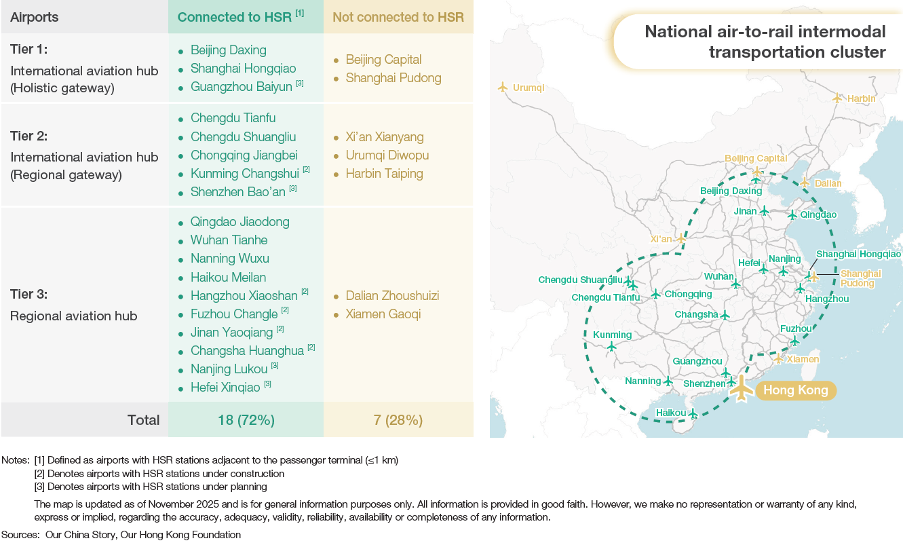
In line with the national strategic direction of promoting air-to-rail intermodal connectivity, the GBA is actively integrating HSR into GBA aviation hubs. However, HKG has yet to be integrated into or respond to these national strategic blueprints. There is a concerning disconnect, as much of the public and relevant stakeholders remain largely unaware of the scale and ambition of these national development plans for air-to-rail intermodal transport. This lack of cognisance extends to a broader failure to fully grasp how these developments are actively reshaping the competitive landscape of regional transportation.
Urgency for Connectivity
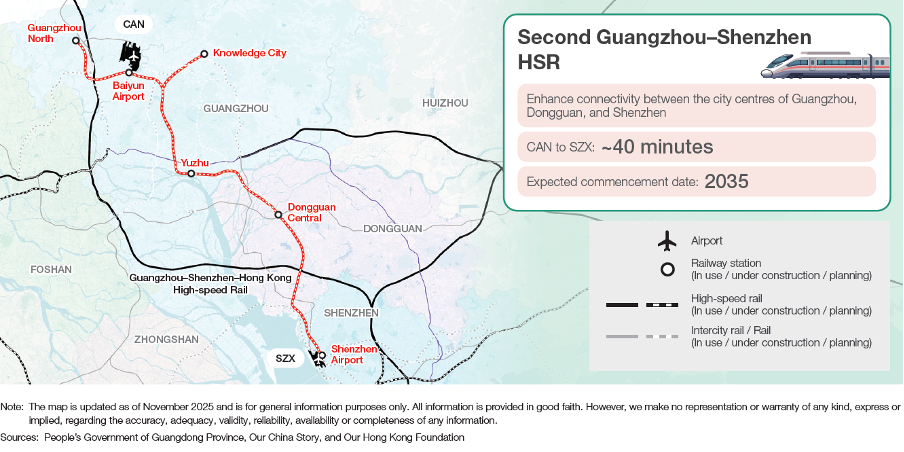
Based on the most updated public information at the time of writing, by 2035 at the latest, the seamless integration of airports in Guangzhou and Shenzhen via the Second Guangzhou–Shenzhen HSR will establish a new standard for regional connectivity. Without decisive action and enhanced connectivity, HKG is to face a significant strategic disadvantage while risking gradual marginalisation. In a "do-nothing" scenario following the commissioning of the HSR, HKG's passenger growth would stall and decline post-2035. This trajectory would prevent the Three-Runway System from reaching its full operational potential, representing a substantial underutilisation of critical infrastructure and diminish Hong Kong's role in the regional aviation landscape.
The Air-to-Rail Nexus
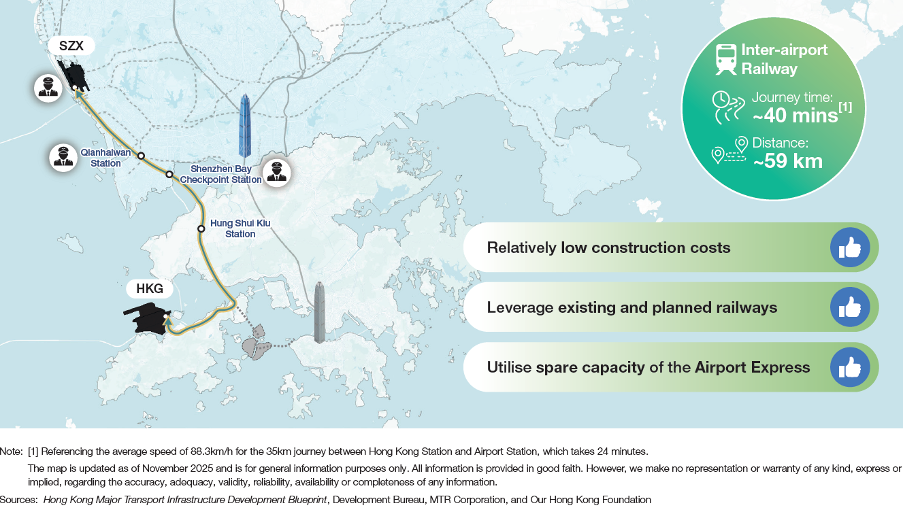
This report, therefore, presents a transformative solution—the IAR. This infrastructure would create a reliable, 40-minute direct connection between Hong Kong and Shenzhen airports, enabling strategic collaboration between the two airports while preserving their distinct operational identities. The IAR would secure HKG’s position within the region’s evolving transportation system, preventing isolation from major passenger flows, thereby allowing the combined Hong Kong–Shenzhen aviation hub would offer passengers access to a greater number of unique destinations. By leveraging complementary international and domestic networks, the hub could increase viable flight connections by up to 144%. Ballpark estimates show that there is a positive return on investment, with present value of economic benefits of HK$87 billion for Hong Kong and HK$24 billion for Shenzhen.
Acknowledging Hong Kong’s fiscal constraints, this report puts forward a pragmatic implementation pathway by building upon the imminent HSWRL. Given its scheduled completion date by 2035, the proposal sets out to extend this vital corridor to both Hong Kong and Shenzhen airports, with the extension developed concurrently to achieve a simultaneous operational date. This synchronised timeline would minimise the time gap with the commissioning of the Second Guangzhou–Shenzhen HSR and, at best, match its operational schedule.
The IAR represents more than a railway connection—it is a strategic imperative for Hong Kong’s future. By ensuring seamless regional connectivity, this infrastructure will secure HKG’s competitive position while unlocking new growth potential. However, the window of opportunity is rapidly closing, and once closed, it may not open again.


The global paradigm for aviation hubs is shifting to multimodal networks. As the nation advances its strategy for a "comprehensive and integrated transportation system", the Greater Bay Area (GBA) is rapidly consolidating into a "world-class airport cluster on the rail". By 2035, the seamless integration of aviation hubs in Guangzhou and Shenzhen via the Second Guangzhou–-Shenzhen High-Speed Rail (HSR) will establish a new standard for regional connectivity. This evolution presents both challenges and opportunities for the Hong Kong International Airport (HKG).
In light of this, Our Hong Kong Foundation (OHKF) is releasing a research report titled “Laying the Tracks to Future-Proof Hong Kong’s Status as an International Aviation Hub”. Riding on the imminent Hong Kong–Shenzhen Western Rail Link (HKWRL), the report presents a transformative solution: the Hong Kong—Shenzhen Inter-Airport Railway (IAR).
National Strategic Blueprints
In line with the national strategic direction of promoting air-to-rail intermodal connectivity, the GBA is actively integrating HSR into GBA aviation hubs. However, HKG has yet to be integrated into or respond to these national strategic blueprints. There is a concerning disconnect, as much of the public and relevant stakeholders remain largely unaware of the scale and ambition of these national development plans for air-to-rail intermodal transport. This lack of cognisance extends to a broader failure to fully grasp how these developments are actively reshaping the competitive landscape of regional transportation.
Urgency for Connectivity
Based on the most updated public information at the time of writing, by 2035 at the latest, the seamless integration of airports in Guangzhou and Shenzhen via the Second Guangzhou–Shenzhen HSR will establish a new standard for regional connectivity. Without decisive action and enhanced connectivity, HKG is to face a significant strategic disadvantage while risking gradual marginalisation. In a "do-nothing" scenario following the commissioning of the HSR, HKG's passenger growth would stall and decline post-2035. This trajectory would prevent the Three-Runway System from reaching its full operational potential, representing a substantial underutilisation of critical infrastructure and diminish Hong Kong's role in the regional aviation landscape.
The Air-to-Rail Nexus
This report, therefore, presents a transformative solution—the IAR. This infrastructure would create a reliable, 40-minute direct connection between Hong Kong and Shenzhen airports, enabling strategic collaboration between the two airports while preserving their distinct operational identities. The IAR would secure HKG’s position within the region’s evolving transportation system, preventing isolation from major passenger flows, thereby allowing the combined Hong Kong–Shenzhen aviation hub would offer passengers access to a greater number of unique destinations. By leveraging complementary international and domestic networks, the hub could increase viable flight connections by up to 144%. Ballpark estimates show that there is a positive return on investment, with present value of economic benefits of HK$87 billion for Hong Kong and HK$24 billion for Shenzhen.
Acknowledging Hong Kong’s fiscal constraints, this report puts forward a pragmatic implementation pathway by building upon the imminent HSWRL. Given its scheduled completion date by 2035, the proposal sets out to extend this vital corridor to both Hong Kong and Shenzhen airports, with the extension developed concurrently to achieve a simultaneous operational date. This synchronised timeline would minimise the time gap with the commissioning of the Second Guangzhou–Shenzhen HSR and, at best, match its operational schedule.
The IAR represents more than a railway connection—it is a strategic imperative for Hong Kong’s future. By ensuring seamless regional connectivity, this infrastructure will secure HKG’s competitive position while unlocking new growth potential. However, the window of opportunity is rapidly closing, and once closed, it may not open again.