







Riding the Wave: Transforming Hong Kong into a Green Mega-Event Capital




Riding the Wave: Transforming Hong Kong into a Green Mega-Event Capital

Our Hong Kong Foundation (OHKF) released a policy research report titled “Riding the Wave: Transforming Hong Kong into a Green Mega-Event Capital” (the Report). Driven by national dual-carbon goals and Hong Kong’s 2050 carbon neutrality commitment, alongside the risk of losing major events amid rising global environmental requirements, integrating sustainability into the mega-event economy is vital to secure Hong Kong’s long-term competitiveness as a leading event host. To steer this industry-wide shift, the Government must drive top-level policy planning. This report sets out 13 actionable recommendations structured across three pillars—Demand, Supply, and Ecosystem—providing a clear roadmap to establish Hong Kong as Asia’s premier “Green Mega-Event Capital”.
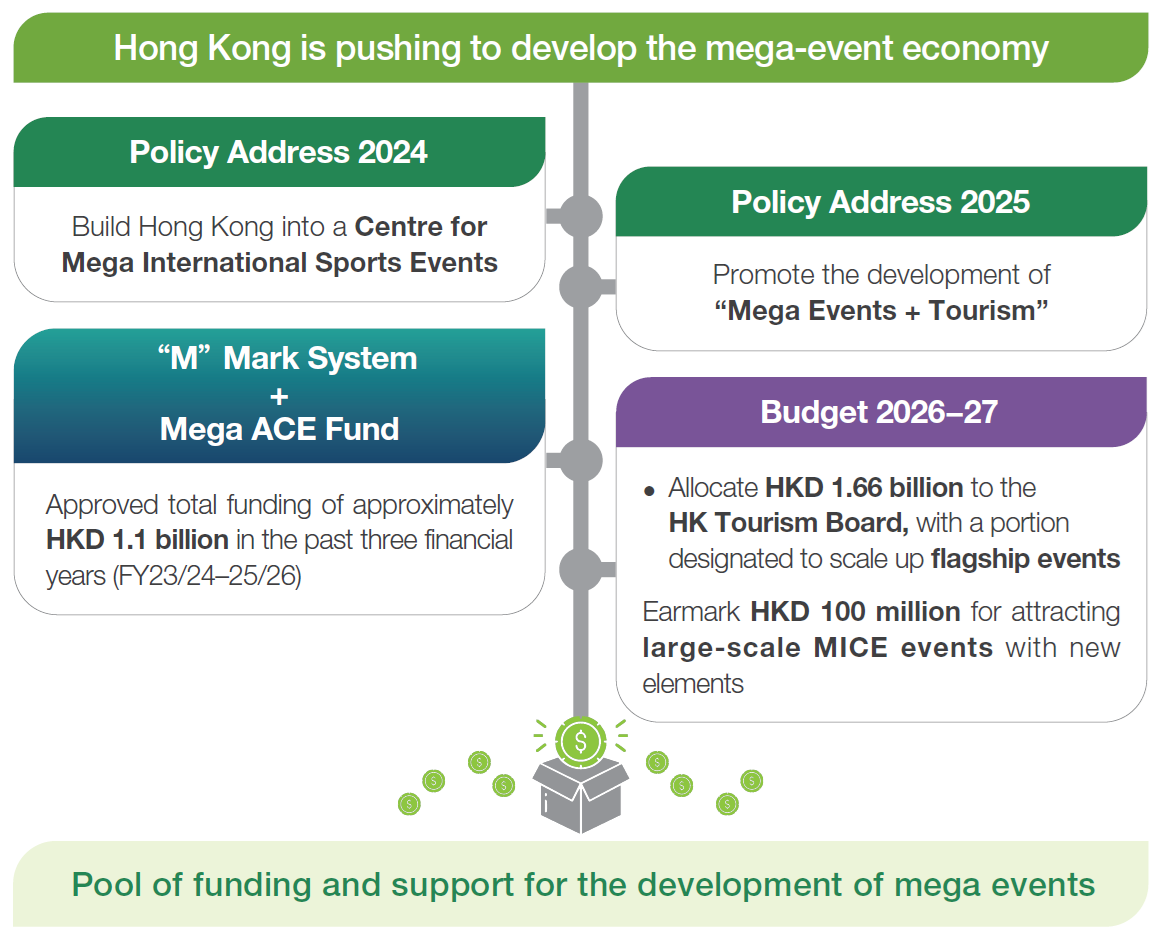
Hong Kong is actively developing its mega-event economy through dedicated funding and policies. In 2025 alone, the city hosted 547 large-scale events, of which 240 were mega events. These mega events attracted around three million tourists, bringing approximately HKD 9.8 billion in spending and HKD 5.7 billion in value added to the local economy.
While Hong Kong demonstrates strong economic performance, international mega events and host cities are placing an increasing emphasis on the environmental footprint of events. Namely, global sports mega events like the 2024 Paris Olympic ambitiously halved their total carbon emissions compared to previous games. Meanwhile, prominent music concerts, such as Coldplay’s “Music of the Spheres” world tour, have successfully implemented innovative carbon reduction initiatives. By utilizing kinetic floors for energy generation and recycling fan wristbands, the tour achieved a 59% reduction in direct carbon emissions compared to their previous global tour. Regional MICE (Meetings, Incentives, Conferences, and Exhibitions) competitors are also leveraging sustainability as a competitive advantage to attract events. Specifically, Singapore demonstrates that sustainability requirements can coexist with continued industry growth. Despite launching the 2022 MICE Sustainability Roadmap, its MICE visitor numbers still grew 33% year-on-year.
In light of this, it is imperative for Hong Kong’s competitiveness as a leading host city to balance environmental and economic benefits in its development of mega events (Figure 2).
Environmentally, pursuing mega-event sustainability not only aligns with Hong Kong’s target of achieving carbon neutrality by 2050 and the Central Government’s dual-carbon targets by 2030 and 2060, but also reinforces Hong Kong’s reputation as a vibrant, sustainable and liveable city, further elevating the city’s international branding.
Economically, via two distinct financial channels, the development of green events is projected to yield a total economic impact of approximately HKD 490 million to HKD 1.53 billion. First, by nurturing a local green event goods and services industry, new economic opportunities will emerge across sectors such as carbon accounting and event waste recycling, with an estimated contribution of HKD 120 million to HKD 480 million to the local economy. Second, hosting green mega-events sustains Hong Kong's competitiveness by retaining existing events that demand eco-friendly provisions and attracting new international events which place increasing emphasis over Environmental, Social, and Governance (ESG) performances. This retained and newly generated economic value is estimated to range from HKD 370 million to HKD 1.05 billion.
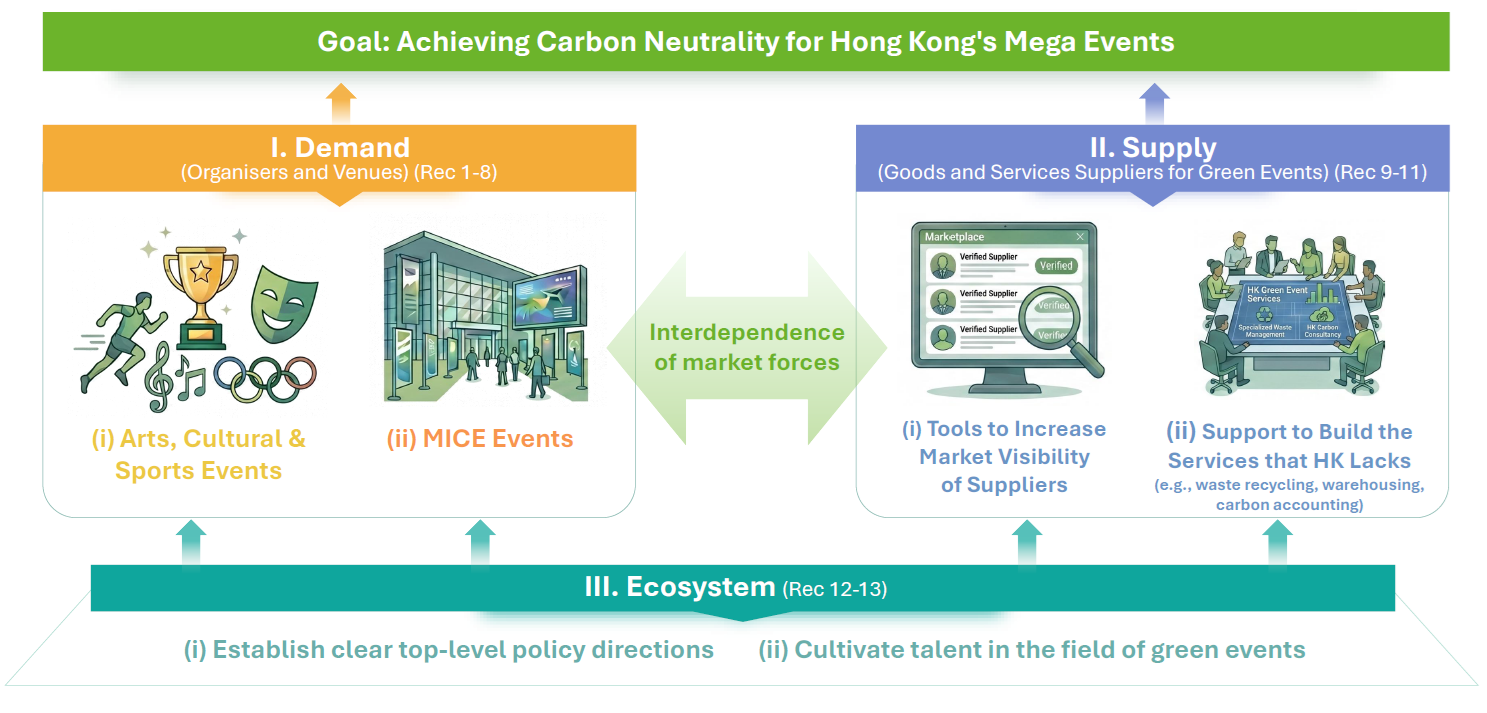
To realise this vision, a comprehensive policy framework with 3 key pillars—Demand, Supply, and Ecosystem—is designed to leverage the Government’s influence over key events and venues, thereby driving the industry-wide transition of Hong Kong’s mega-event sector. The recommendations from the first two pillars should be implemented simultaneously, underpinned by the broader policy framework of the third pillar.
Demand (Recommendation 1-8)
To create the initial market signal and stimulate demand for green events, this pillar targets two categories of events: arts, cultural, and sports events receiving public funding (Recommendation 1-4), and MICE Events held in government-affiliated venues (specifically the Hong Kong Convention and Exhibition Centre (HKCEC) and AsiaWorld-Expo (AWE)) (Recommendation 5-8).
The first four recommendations leverage the Government’s direct control over existing funding mechanisms, namely the “M” Mark System and the Mega ACE Fund, to progressively introduce environmental mandates while providing corresponding financial and policy support for event organisers. Notably, Recommendation 1 outlines the gradual integration of a “Green Event Plan” into the funding application process. Through this Plan, event organizers are incentivized to carefully plan an event’s sustainability pre-event, implement low-carbon measures during-event, and offset residual emissions post-event.
Targeting the MICE sector, the Report identifies that most MICE events are held in government-affiliated venues (HKCEC and AWE). The following recommendations utilise venue management contracts to drive key green initiatives, including reusable booths, precise electricity measurement facilities, and material donation systems, across the pre-, during-, and post-event stages.
| I. Demand (organisers) | |
| Large-scale events funded by the “M” Mark System and Mega ACE Fund | |
| 1 [Pre-event] | Require applicants to submit a “Green Event Plan” |
| 2 [During-event] | Designate publicly funded mega events to pilot green and sustainability measures |
| 3 [Post-event] | Incorporate “Sustainability Performance” into post-event evaluation |
| 4 [Post-event] | Require funded mega events to adopt a local carbon offsetting mechanism |
| MICE events held in government-affiliated venues (HKCEC and AWE) | |
| 5 [Overall] | Commerce and Economic Development Bureau and Transport and Logistics Bureau to incorporate “Green Venue Management Clauses” into venue management contracts |
| 6 [Pre-event] | Venues to provide rental discounts to incentivise exhibitors’ adoption of reusable booths |
| 7 [During-event] | Venues to accurately and comprehensively measure event electricity consumption |
| 8 [Post-event] | Venues to establish a venue-based materials donation and circular reuse network |
Supply (Recommendation 9-11)
Alongside stimulating demand, the supply of green event goods and services must be developed simultaneously. By addressing major operational challenges—such as the difficulty in identifying credible suppliers, the “green premium”, a lack of storage facilities, and limited downstream recycling technologies—the following recommendations aim to prevent greenwashing, mitigate investment risks and cost, while building supplier confidence.
| II. Supply (goods and services suppliers for green events) | |
| 9A | Environmental Protection Department to collaborate with Hong Kong Quality Assurance Agency to establish a “Green Supplier Directory” |
| 9B | Environmental Protection Department to relaunch the “E-Green Voucher Scheme” to offset the green premium |
| 10 | Government to endorse and subsidise local “Hong Kong Green Event Certification” |
| 11A | Government to support the development and rental of green event storage facilities |
| 11B | Environmental Protection Department to leverage the Recycling Fund and EcoPark to introduce event-specific waste treatment technologies |
Ecosystem (Recommendation 12-13)
To sustain the momentum generated by demand- and supply-side interventions, top- level policy support, along with talent development, are essential to establish a green event ecosystem.
| III. Ecosystem (top-level policy and talent development) | |
| 12 | Government to incorporate “Green Mega Events” into top-level policy |
| 13A | UGC-funded universities to integrate carbon management and environmental modules into mainstream business degrees |
| 13B | Upskill Hong Kong to provide in-service upskilling and career transition training for the green event sector |
The synergy of recommendations across these three pillars will drive market maturation and economies of scale, successfully reducing operational costs. By creating a self-sustaining ecosystem that establishes carbon neutrality as the new norm for large-scale events, Hong Kong can establish itself as Asia’s leading “Green Mega-Event Capital”.




Our Hong Kong Foundation (OHKF) released a policy research report titled “Riding the Wave: Transforming Hong Kong into a Green Mega-Event Capital” (the Report). Driven by national dual-carbon goals and Hong Kong’s 2050 carbon neutrality commitment, alongside the risk of losing major events amid rising global environmental requirements, integrating sustainability into the mega-event economy is vital to secure Hong Kong’s long-term competitiveness as a leading event host. To steer this industry-wide shift, the Government must drive top-level policy planning. This report sets out 13 actionable recommendations structured across three pillars—Demand, Supply, and Ecosystem—providing a clear roadmap to establish Hong Kong as Asia’s premier “Green Mega-Event Capital”.
Hong Kong is actively developing its mega-event economy through dedicated funding and policies. In 2025 alone, the city hosted 547 large-scale events, of which 240 were mega events. These mega events attracted around three million tourists, bringing approximately HKD 9.8 billion in spending and HKD 5.7 billion in value added to the local economy.
While Hong Kong demonstrates strong economic performance, international mega events and host cities are placing an increasing emphasis on the environmental footprint of events. Namely, global sports mega events like the 2024 Paris Olympic ambitiously halved their total carbon emissions compared to previous games. Meanwhile, prominent music concerts, such as Coldplay’s “Music of the Spheres” world tour, have successfully implemented innovative carbon reduction initiatives. By utilizing kinetic floors for energy generation and recycling fan wristbands, the tour achieved a 59% reduction in direct carbon emissions compared to their previous global tour. Regional MICE (Meetings, Incentives, Conferences, and Exhibitions) competitors are also leveraging sustainability as a competitive advantage to attract events. Specifically, Singapore demonstrates that sustainability requirements can coexist with continued industry growth. Despite launching the 2022 MICE Sustainability Roadmap, its MICE visitor numbers still grew 33% year-on-year.
In light of this, it is imperative for Hong Kong’s competitiveness as a leading host city to balance environmental and economic benefits in its development of mega events (Figure 2).
Environmentally, pursuing mega-event sustainability not only aligns with Hong Kong’s target of achieving carbon neutrality by 2050 and the Central Government’s dual-carbon targets by 2030 and 2060, but also reinforces Hong Kong’s reputation as a vibrant, sustainable and liveable city, further elevating the city’s international branding.
Economically, via two distinct financial channels, the development of green events is projected to yield a total economic impact of approximately HKD 490 million to HKD 1.53 billion. First, by nurturing a local green event goods and services industry, new economic opportunities will emerge across sectors such as carbon accounting and event waste recycling, with an estimated contribution of HKD 120 million to HKD 480 million to the local economy. Second, hosting green mega-events sustains Hong Kong's competitiveness by retaining existing events that demand eco-friendly provisions and attracting new international events which place increasing emphasis over Environmental, Social, and Governance (ESG) performances. This retained and newly generated economic value is estimated to range from HKD 370 million to HKD 1.05 billion.
To realise this vision, a comprehensive policy framework with 3 key pillars—Demand, Supply, and Ecosystem—is designed to leverage the Government’s influence over key events and venues, thereby driving the industry-wide transition of Hong Kong’s mega-event sector. The recommendations from the first two pillars should be implemented simultaneously, underpinned by the broader policy framework of the third pillar.
Demand (Recommendation 1-8)
To create the initial market signal and stimulate demand for green events, this pillar targets two categories of events: arts, cultural, and sports events receiving public funding (Recommendation 1-4), and MICE Events held in government-affiliated venues (specifically the Hong Kong Convention and Exhibition Centre (HKCEC) and AsiaWorld-Expo (AWE)) (Recommendation 5-8).
The first four recommendations leverage the Government’s direct control over existing funding mechanisms, namely the “M” Mark System and the Mega ACE Fund, to progressively introduce environmental mandates while providing corresponding financial and policy support for event organisers. Notably, Recommendation 1 outlines the gradual integration of a “Green Event Plan” into the funding application process. Through this Plan, event organizers are incentivized to carefully plan an event’s sustainability pre-event, implement low-carbon measures during-event, and offset residual emissions post-event.
Targeting the MICE sector, the Report identifies that most MICE events are held in government-affiliated venues (HKCEC and AWE). The following recommendations utilise venue management contracts to drive key green initiatives, including reusable booths, precise electricity measurement facilities, and material donation systems, across the pre-, during-, and post-event stages.
| I. Demand (organisers) | |
| Large-scale events funded by the “M” Mark System and Mega ACE Fund | |
| 1 [Pre-event] | Require applicants to submit a “Green Event Plan” |
| 2 [During-event] | Designate publicly funded mega events to pilot green and sustainability measures |
| 3 [Post-event] | Incorporate “Sustainability Performance” into post-event evaluation |
| 4 [Post-event] | Require funded mega events to adopt a local carbon offsetting mechanism |
| MICE events held in government-affiliated venues (HKCEC and AWE) | |
| 5 [Overall] | Commerce and Economic Development Bureau and Transport and Logistics Bureau to incorporate “Green Venue Management Clauses” into venue management contracts |
| 6 [Pre-event] | Venues to provide rental discounts to incentivise exhibitors’ adoption of reusable booths |
| 7 [During-event] | Venues to accurately and comprehensively measure event electricity consumption |
| 8 [Post-event] | Venues to establish a venue-based materials donation and circular reuse network |
Supply (Recommendation 9-11)
Alongside stimulating demand, the supply of green event goods and services must be developed simultaneously. By addressing major operational challenges—such as the difficulty in identifying credible suppliers, the “green premium”, a lack of storage facilities, and limited downstream recycling technologies—the following recommendations aim to prevent greenwashing, mitigate investment risks and cost, while building supplier confidence.
| II. Supply (goods and services suppliers for green events) | |
| 9A | Environmental Protection Department to collaborate with Hong Kong Quality Assurance Agency to establish a “Green Supplier Directory” |
| 9B | Environmental Protection Department to relaunch the “E-Green Voucher Scheme” to offset the green premium |
| 10 | Government to endorse and subsidise local “Hong Kong Green Event Certification” |
| 11A | Government to support the development and rental of green event storage facilities |
| 11B | Environmental Protection Department to leverage the Recycling Fund and EcoPark to introduce event-specific waste treatment technologies |
Ecosystem (Recommendation 12-13)
To sustain the momentum generated by demand- and supply-side interventions, top- level policy support, along with talent development, are essential to establish a green event ecosystem.
| III. Ecosystem (top-level policy and talent development) | |
| 12 | Government to incorporate “Green Mega Events” into top-level policy |
| 13A | UGC-funded universities to integrate carbon management and environmental modules into mainstream business degrees |
| 13B | Upskill Hong Kong to provide in-service upskilling and career transition training for the green event sector |
The synergy of recommendations across these three pillars will drive market maturation and economies of scale, successfully reducing operational costs. By creating a self-sustaining ecosystem that establishes carbon neutrality as the new norm for large-scale events, Hong Kong can establish itself as Asia’s leading “Green Mega-Event Capital”.