






Application and Development of Artificial Intelligence in Primary and Secondary Education




Application and Development of Artificial Intelligence in Primary and Secondary Education

Artificial intelligence (AI) is profoundly reshaping the education landscape. To understand the actual applications, needs, and challenges of AI in Hong Kong’s education system, Our Hong Kong Foundation (OHKF) has published a policy advocacy study titled "Application and Development of Artificial Intelligence (AI) in Primary and Secondary Education." The research aims to provide evidence-driven analysis and recommendations on how AI can empower education.
Between July and December 2025, OHKF conducted questionnaire surveys and stakeholder interviews with 1,200 primary and secondary school principals, teachers, and students. The survey findings highlighted three key observations:
AI is deeply integrated into teaching and learning: Over 90% of teachers and students use AI tools in their teaching and learning processes, respectively (91% of teachers, 95% of students).
Teachers express concern that AI may undermine students' higher order thinking abilities (such as problem-solving and critical thinking) while also posing risks to privacy. Students’ awareness of the privacy risks posed by AI tools needs to be enhanced.
Even though many teachers indicate that their schools provide AI-related training, teachers’ self-assessed proficiency with AI tools is only 5 out of 10, and students’ is 6.5. There is also a disparity across subjects in how teachers instruct students on using AI tools, with some having not yet explored ways to integrate AI into teaching and learning. This suggests that current teacher training may be insufficient to build effective AI skills among teachers and students.
Based on the key observations outlined above, the research team proposes five policy directions:
Developing a pedagogy-based framework for AI applications.
Establishing an AI learning platform integrating resources across Hong Kong.
Constructing an AI literacy curriculum spanning primary and secondary education.
Implementing interdisciplinary professional development programmes for teachers.
Enhancing AI literacy training for pre-service teachers.
Through these initiatives, the study aims to foster a deep and responsible integration of AI within education, genuinely enhancing teaching effectiveness while cultivating students' essential competencies for future readiness.


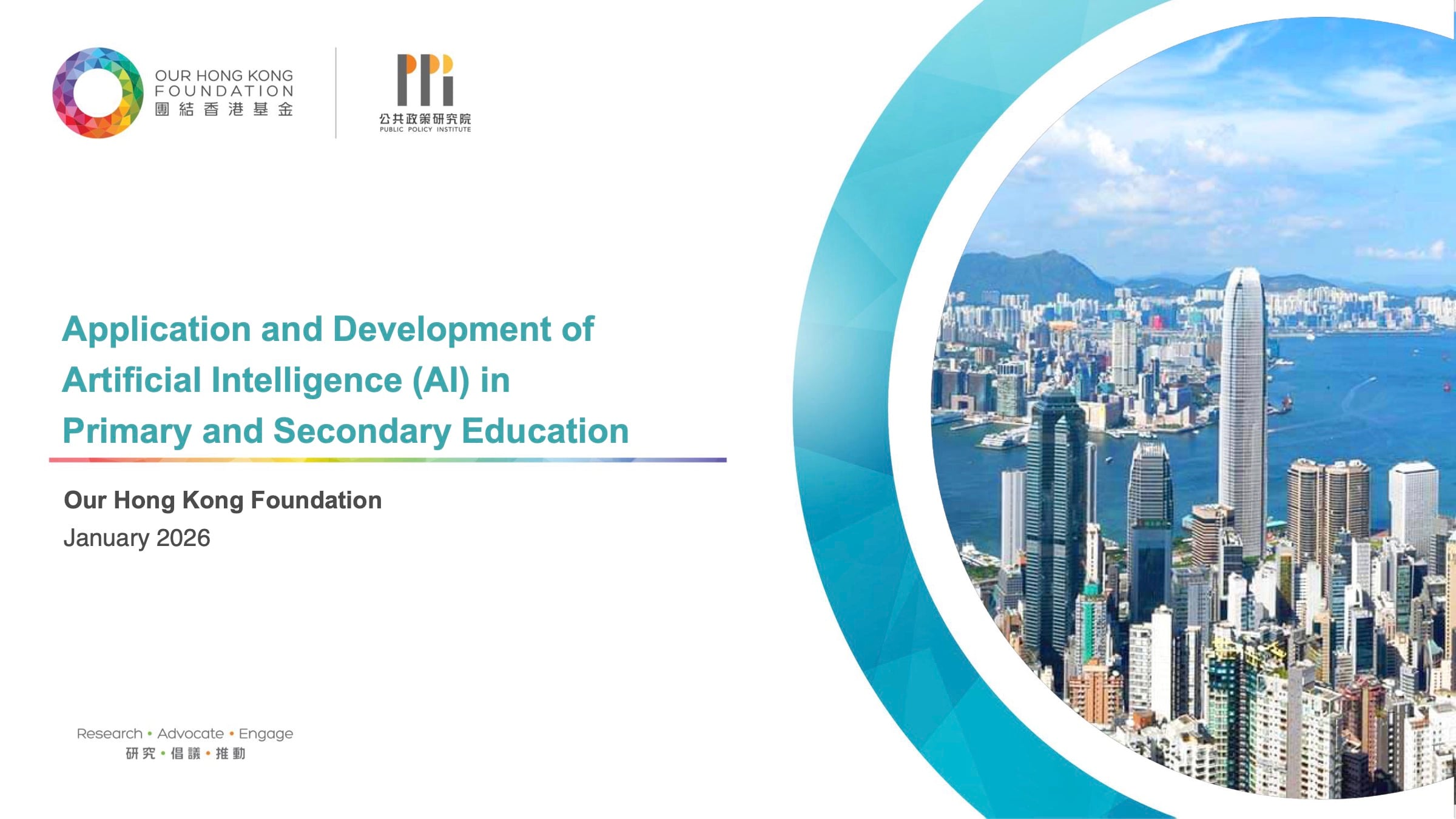


Artificial intelligence (AI) is profoundly reshaping the education landscape. To understand the actual applications, needs, and challenges of AI in Hong Kong’s education system, Our Hong Kong Foundation (OHKF) has published a policy advocacy study titled "Application and Development of Artificial Intelligence (AI) in Primary and Secondary Education." The research aims to provide evidence-driven analysis and recommendations on how AI can empower education.
Between July and December 2025, OHKF conducted questionnaire surveys and stakeholder interviews with 1,200 primary and secondary school principals, teachers, and students. The survey findings highlighted three key observations:
AI is deeply integrated into teaching and learning: Over 90% of teachers and students use AI tools in their teaching and learning processes, respectively (91% of teachers, 95% of students).
Teachers express concern that AI may undermine students' higher order thinking abilities (such as problem-solving and critical thinking) while also posing risks to privacy. Students’ awareness of the privacy risks posed by AI tools needs to be enhanced.
Even though many teachers indicate that their schools provide AI-related training, teachers’ self-assessed proficiency with AI tools is only 5 out of 10, and students’ is 6.5. There is also a disparity across subjects in how teachers instruct students on using AI tools, with some having not yet explored ways to integrate AI into teaching and learning. This suggests that current teacher training may be insufficient to build effective AI skills among teachers and students.
Based on the key observations outlined above, the research team proposes five policy directions:
Developing a pedagogy-based framework for AI applications.
Establishing an AI learning platform integrating resources across Hong Kong.
Constructing an AI literacy curriculum spanning primary and secondary education.
Implementing interdisciplinary professional development programmes for teachers.
Enhancing AI literacy training for pre-service teachers.
Through these initiatives, the study aims to foster a deep and responsible integration of AI within education, genuinely enhancing teaching effectiveness while cultivating students' essential competencies for future readiness.